
Warren Pickering stood up in Melbourne on Tuesday and said the mistakes of his twenties still hurt. That’s the short version of a long day — and you should hear the rest without the spin.
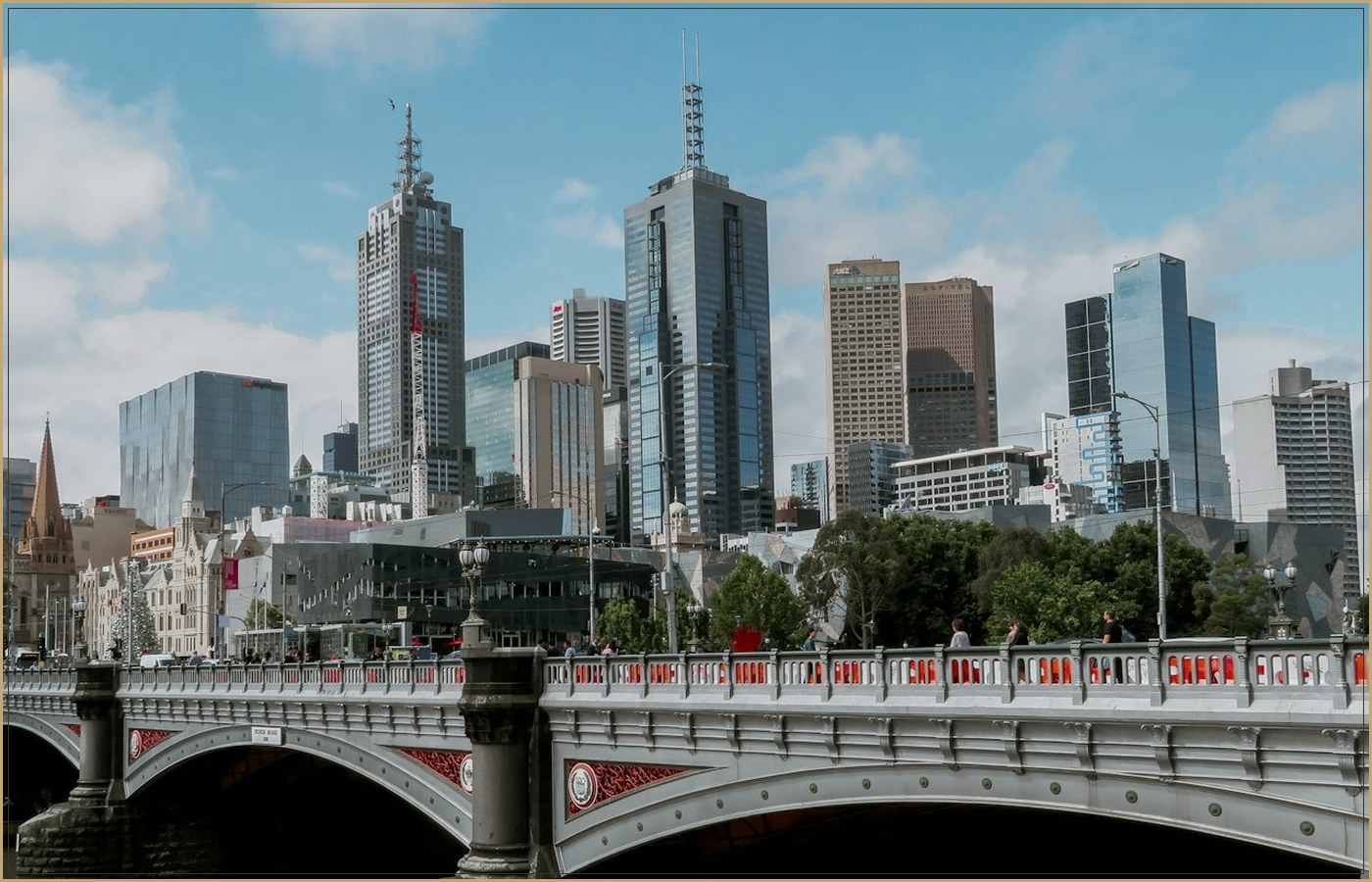
Here’s what happened. One Nation’s Victorian leader walked into a rented room on the twenty-ninth floor of Crown Towers on Tuesday, 8 September 2026, daughter and stepson beside him, and took questions on drug use, drink-driving, and a former partner’s interview in The Australian. The Age’s Patrick Hatch, Clay Lucas and Angelica Snowden put him on that floor. AAP’s Nick Wilson, Holly Hales and Melissa Meehan, carried by the Kyabram Free Press, put him in Melbourne with the same core admissions. The ABC and Guardian Australia were asked to leave before the conference began. You should hear the timeline before the slogans.
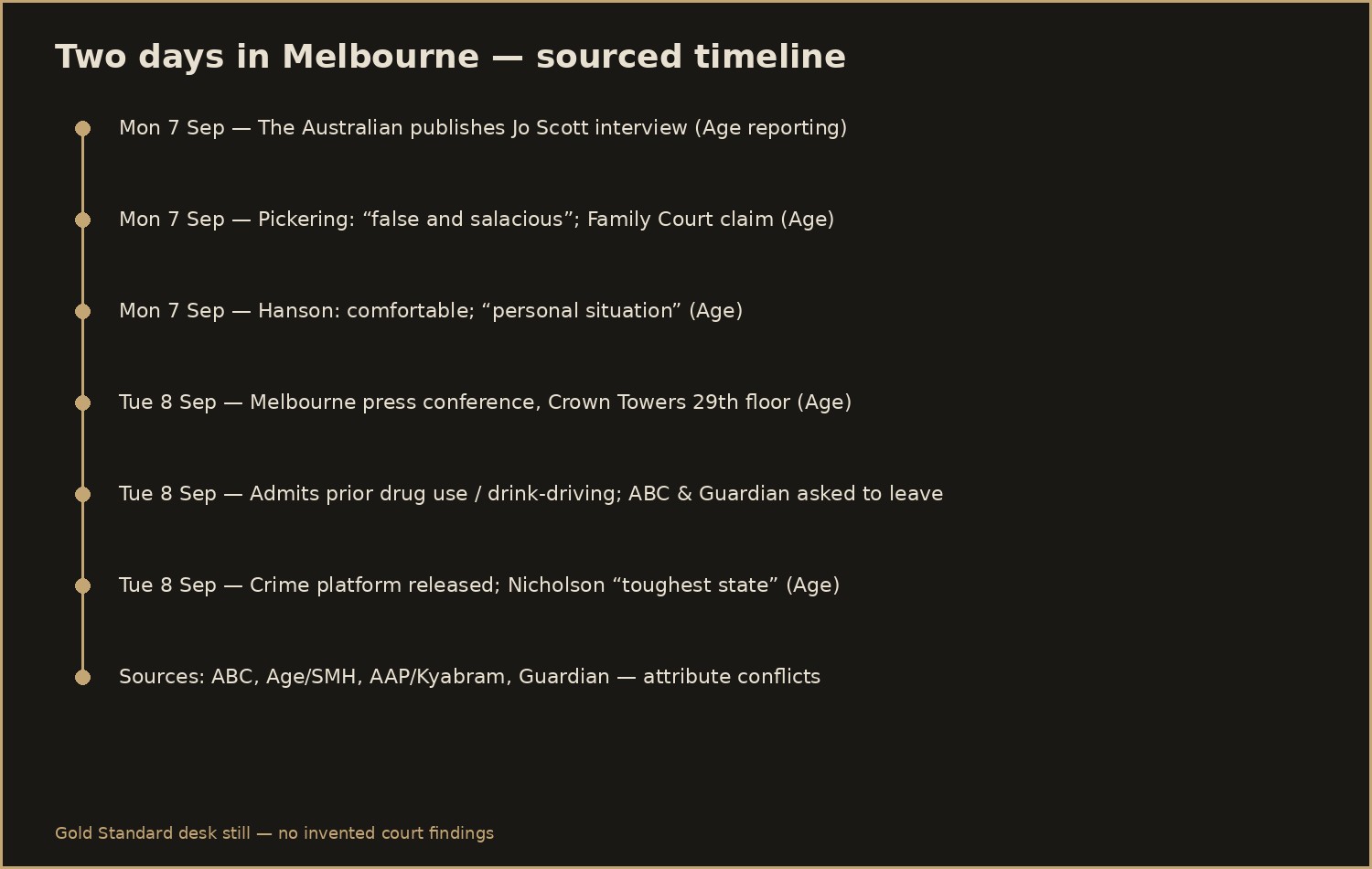
Monday came first. You need that day before Tuesday makes sense. The Australian published an interview with Jo Scott, Pickering’s former partner of almost two decades. The Age’s Monday reporting says the relationship ran from about 2000 to 2018, and that the allegations relate roughly to 2005 to 2014. Scott told the paper the pair had used marijuana and amphetamines — including crystal meth, or ice — in the home they shared with their daughter and her three sons from a previous marriage. Handwritten notes purportedly from Pickering to Scott were published with the interview, according to The Age, including language apologising for behaviour while “on the shit” and acknowledging “using substances.”
Pickering’s first public answer, on Monday, was denial. In a statement reported by The Age, he called Scott’s claims “false and salacious.” He said she had made false allegations against him since 2010. He put it this way, as The Age quoted him:
“The [Family] Court has dismissed these allegations and has consistently given me sole custody of our daughter.”
And:
“These allegations are false. They’re extremely hurtful, and I just hope the public can see through them.”
That is his claim about the Family Court. It is what he said. Independent court transcripts are not in the public reporting used for this desk piece, so you get the claim with his name on it, not a re-finding from this paper.
Pauline Hanson stood with him the same day. At a Monday press conference, the federal One Nation leader said she was comfortable with the then-forty-three-year-old — AAP and the ABC use forty-three; The Age’s Tuesday piece says he is now forty-two; both trails stay in the book — leading the Victorian branch. The Age recorded her this way:
“I’m happy [with him]. These are allegations that have been put to Warren Pickering, and he’s denied those allegations. I will not be saying any more about it. It is a personal situation.”
Barnaby Joyce, now a One Nation senator in the same reporting trail, noted that Pickering later joined the Australian Army after the alleged period, which included security vetting. That is The Age’s Monday framing, not a medical or military dossier. It sits next to Pickering’s own Tuesday claim that he disclosed prior drug use when he applied to the Australian Defence Force at twenty-eight.
By Tuesday afternoon the denial had narrowed. He didn’t walk into Crown Towers and repeat Monday’s blank rejection. He admitted a history of illicit drug use in his twenties. He admitted losing his licence for drink-driving. He denied being a drug addict. He denied using crystal meth, or ice, in the home with children. On whether he had used “methamphetamines” at all, the newsroom trails split, and you should see both.
Start with AAP as the Kyabram Free Press carried it. Wilson, Hales and Meehan report that Pickering admitted taking speed, ecstasy and marijuana before joining the ADF at twenty-eight. They report that he denied ever using methamphetamines, or ice, including in the same home as the children, or ever being a drug addict. He told reporters:
“The mistakes I made in my 20s hurt people,”
and
“They hurt me. They hurt people I loved and I will live with that forever.”
On party support:
“The party has been entirely supportive every step of the way,”
including Hanson. On what he told the party when he applied:
“A lot of these details came out later when it was identified that (Ms Scott) was posting things online publicly,”
Asked how much he had disclosed directly to Hanson, he said:
“I make sure the right people at the time are aware of everything they need to be aware of,”
On the allegations he still rejected:
“(The allegations) are extremely hurtful and I just hope the public can see through them,”
And on who he is now:
“I'm proud of the man I am today,”
His daughter Jhett told the same AAP pool:
“My father has always been there for us ... at the end of the day, we always came first,”
That is the Kyabram/AAP trail. Speed, ecstasy, marijuana. Denial of methamphetamines and ice. Supportive family at the table. Lawyers engaged for a potential defamation claim, without naming the target in that wire.
Now the ABC trail — published Tuesday under the line that he admits previous drug use. The ABC calls him a father-of-four, forty-three, standing for Pakenham in November. It says he used drugs including speed, ecstasy and marijuana in his twenties, denied his former partner’s claim that they used ice, and said he stopped before joining the ADF at twenty-eight and disclosed prior use on the application. Verbatim from the ABC:
“Never would I have ever said that I was somebody that was a drug addict,”
and
“I did use them as a young man and I'm not proud of that.”
The ABC also records the regret line that matches AAP’s pool:
“The mistakes I made in my 20s hurt people. They hurt me, they hurt people I loved and I will live with that forever,”
and a further child-focused line:
“I always wish for these kids that I was able to do better. I did the best that I could with what I had to work with at the time.”
On drink-driving, the ABC says he admitted losing his licence at eighteen and twenty, then again a decade later. He said he had never been to prison. That “decade later” third loss is the bit AAP’s Kyabram write-up, in the version used here, only partially mirrors — AAP stresses the eighteen and twenty “low level” losses; the ABC and Guardian add the later third loss. Attribute that difference. Do not flatten it.
Guardian Australia’s Tuesday piece, which its own reporters were barred from attending in person, still reported the conference from the available pool and follow-up. The Guardian says Pickering admitted he “made mistakes” in his twenties, including using ecstasy, methamphetamines and marijuana, losing his licence multiple times for drink-driving, and hurting people he loved. It also says he denied Scott’s claim that he smoked ice in front of children, and that he was considering legal action against The Australian. Accompanied by James Ashby, One Nation’s national director, and his daughter and stepson, Pickering said he was “no angel” as a young man. The Guardian records:
“Never would I have ever said that I was somebody who was a drug addict. I did use them … as a young man and I’m not proud of that,”
Pressed on ice, the Guardian has this exchange: Pickering said “ice is not on that list.” When a reporter said methamphetamines are ice, he replied “Well, speed.” Then:
“Look, guys, I’m clearly not as familiar with the terms … as you would like me to be,”
On drink-driving, Guardian verbatim:
“I believe I lost my licence for drink driving as an 18-year-old, and again as a 20-year-old, and then probably a decade later, I believe they were low-level drink driving,”
That terminology fight? It’s the hinge between newsrooms. AAP’s wire has him denying methamphetamines and ice. The Age and SMH Tuesday reporting says he admitted marijuana and methamphetamines after Monday’s denial, while denying crystal meth or ice, and quotes the same unfamiliarity line. The Guardian lists methamphetamine among the substances he named, then records the ice-versus-speed clarification. The ABC sticks to speed, ecstasy and marijuana and a denial of ice. You are looking at the same room through different notebooks. This desk is not picking a chemical winner. It is naming the trails.
The Age and SMH add place and family detail the wires also touch. The conference was in a rented event room on the twenty-ninth floor of Crown Towers. Pickering was flanked by his daughter and stepson. He maintained he had never used drugs while their children were in the house, denied he had been a “drug addict,” and said he had not used illicit drugs for at least sixteen years. Last use, he told The Age’s reporters, would have been when he was “26, maybe 27.” He said he disclosed previous drug use during Army security vetting at twenty-eight. The Age quotes him:
“I’ve never made the suggestion that I’m any type of angel,”
and
“I was a young man in my 20s, not unlike everybody else that has ever been a young man in their 20s. I made mistakes.”
and
“What I did since then was change my life dramatically for the benefit of not only my children, but for myself and those around me.”
Nine.com.au’s Emily Bennett, filing Tuesday afternoon, has him saying he had “utilised” illegal drugs in his twenties, including “speed, amphetamines, ecstasy and marijuana,” and that the drink-driving losses were “low-level.” That Nine list puts amphetamines next to speed — another notebook difference you should see rather than erase.
Jo Scott did not treat Tuesday as closure. In a written statement reported by The Age and SMH, she called the conference a “lost opportunity for him to come clean with Victorians about his past.” She put it this way:
“Warren’s claim that he simply ‘dabbled’ in drugs as a young man, and that he was a ‘casual drug user’ was a masterclass in deceit and dishonesty,”
and
“His claims were false, and he knows them to be false,”
and
“The greatest contribution Warren Pickering could make to One Nation, and to the people of Victoria, would be to resign immediately.”
Pickering’s stepson, Johnny Scott, told the Age conference that his mother had “a vendetta against Warren and has for many years,” and that “My mother has a past and she’s stuck in that past.” Scott confirmed she has been estranged “for many years” from her son and Pickering’s stepson. Johnny confirmed he had messaged Jo in recent days to tell her to “get back to Queensland,” per The Age. That is a family fight spilling into a state campaign. It is not this paper’s job to referee it beyond the quotes.
Ashby spoke before and beside Pickering. The ABC reports that Ashby addressed a handwritten note and an alleged issue with a home-buying grant detailed in The Australian. Ashby said Pickering was willing to “own” an issue with the grant and had been unaware of it until the newspaper raised it. Verbatim from the ABC:
“He's quite aware of the importance of owning the past and — equally as important — providing hope for those who might be in a similar set of circumstances,”
and
“His story is not unique. If anything, it demonstrates how someone young and determined can get their life back on track.”
On the note referencing “sexual deviance,” Guardian Australia reports Ashby telling reporters it related to “behaviour that involved the couple’s open relationship.” Ashby’s words, as the Guardian has them:
“They opened that relationship to a third person, and at the same time, Mr Pickering was exploring his own sexuality,”
The Age has Pickering saying a note apologising for “sexual deviance” related to him cheating on his former partner, and quoting him:
“We’d opened our relationship, but that hadn’t given me permission to do some of the things I’d done with respect to exploring sexuality,”
Again: two notebooks, same note, slightly different gloss. Both are on the record. Neither is expanded here into scenes this desk did not witness.
Then the door policy. Before the conference began, reporters from the ABC and The Guardian were asked to leave. AAP/Kyabram says the media conference was closely guarded and continues a trend of the minor party turning select outlets away. The Guardian says reporters from The Australian were able to attend at Crown Casino, while Guardian Australia and ABC journalists were asked by Ashby to leave after identifying their outlets. The Age says reporters from those outlets, as well as The Age, have recently been barred from a number of One Nation press conferences, including when Victorian state candidates were announced. Ashby, per the ABC, said it was his decision, not Pickering’s, to ban select outlets, without specifying why. Hanson has previously said outlets were being denied entry because she was “not putting up with their rubbish,” the ABC notes. Pickering, asked about the removals, told the ABC:
“We have a position with the party to ban those particular news outlets.”
and
“I'm not going to impede on [the] party's judgement ... I will take the judgement of the media advisers.”
The Age has a near-match:
“I’m not going to impede on the parties’ judgment. I’m still learning with respect to campaigning,”
Peter Greste, executive director of the Alliance for Journalists’ Freedom, answered the access fight in a statement carried by AAP/Kyabram:
“Any politician deciding who gets to scrutinise them is practising censorship, and in a democracy, that's something we should never accept.”
That line is not a One Nation press release. It is a press-freedom group answering a closed door. You can weigh it next to Ashby’s ownership of the ban and Pickering’s deference to party media advisers.
Why does any of this land with force in September 2026? Here’s the politics under the personal. Because the Victorian election is Saturday, 28 November, and Pickering is not a fringe name on a how-to-vote card. Pauline Hanson named him One Nation’s Victorian leader in early August. He is the party’s candidate for the marginal lower-house seat of Pakenham. The ABC’s 3 August context piece, and Tuesday’s follow-up, both place him there after prior runs: the 2022 state election and the 2025 federal Senate ticket, both unsuccessful. AAP adds the work history he has put on the public record — construction, combat engineer in the Army, Queensland mining, then a return to Victoria. That is biography, not mythology.
Pakenham sits on Melbourne’s south-eastern growth edge, in Cardinia country, where new estates meet older paddocks and the railway still marks the town. You do not need invented colour to see why a state leader would plant himself there. Marginal seats decide governments. One Nation wants lower-house skin in Victoria, not only upper-house balance-of-power dreams. Pickering is the face of that bet. Tuesday’s conference was personal history colliding with that bet under lights.

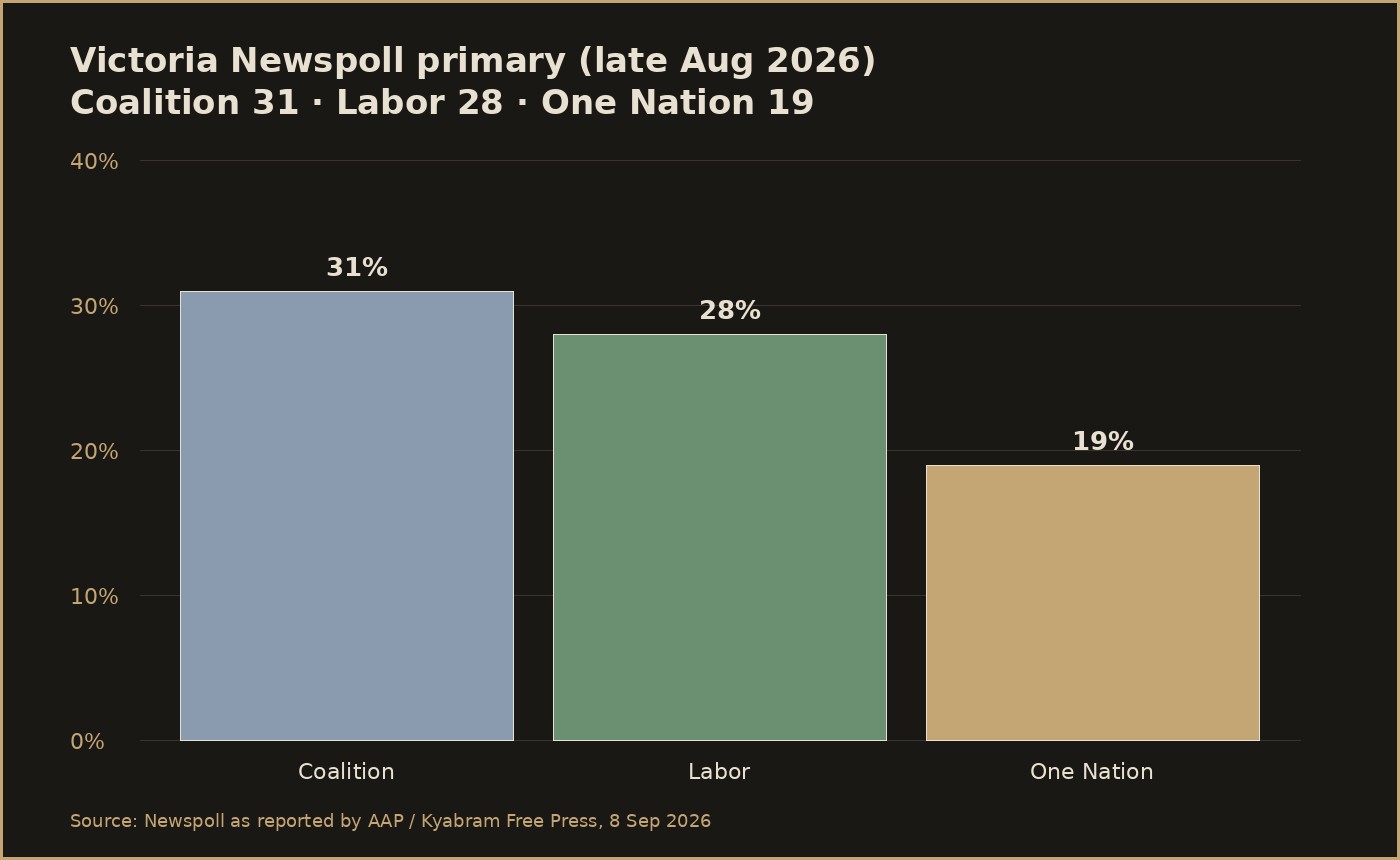
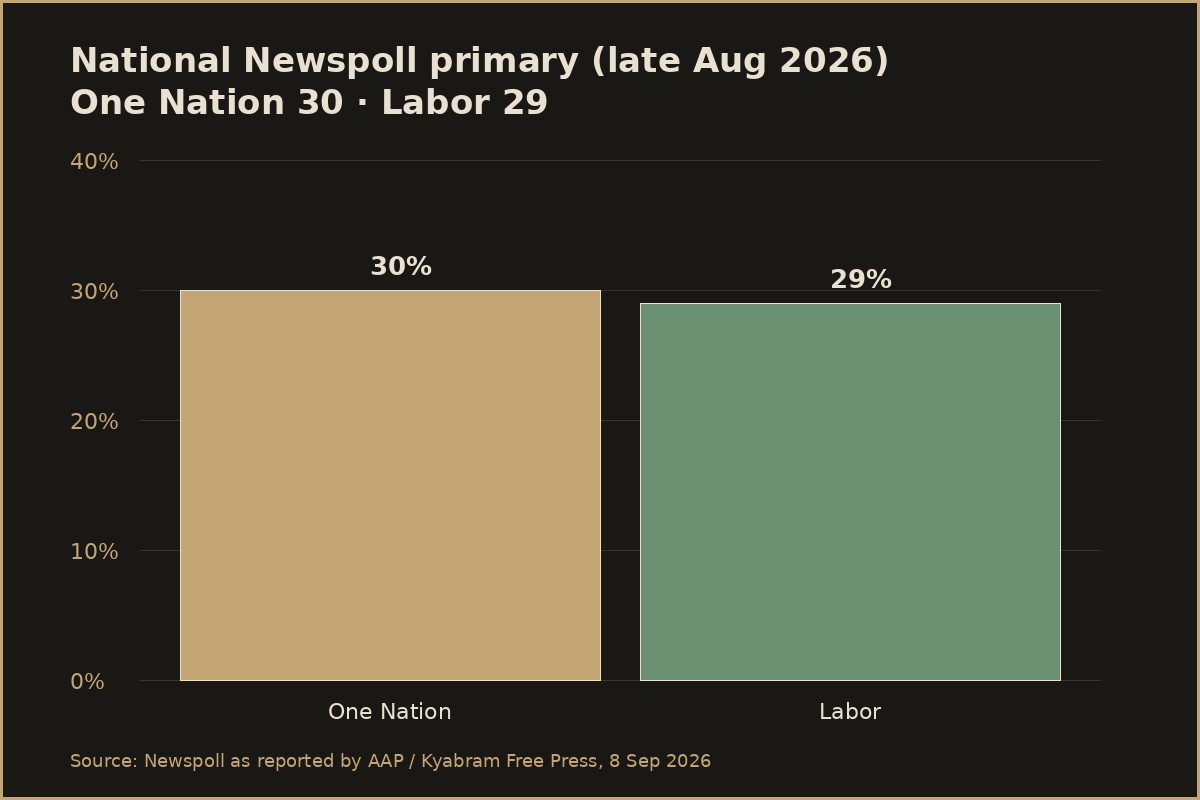
Polling context, attributed, not invented. AAP/Kyabram reports that nationally, primary support for One Nation stood at 30 per cent, ahead of Labor on 29 per cent, according to a Newspoll published in late August. In Victoria, a separate Newspoll had the Coalition on 31 per cent, Labor on 28, and One Nation on 19. Those are the only poll numbers used here. No other survey is smuggled in. The national primary is hot; the Victorian primary is softer for One Nation and still large enough to matter in preferences and upper-house races. Labor has previously said polling suggested Victoria was on track for Australia’s first Liberal–One Nation government after November, the ABC notes; the Liberal Party denies it will enter an alliance with One Nation. That dispute is older than Tuesday’s conference. Tuesday simply raised the price of the conversation.
Here’s the juxtaposition The Age flagged in plain language. The same media conference that handled Pickering’s past was used to release details of One Nation’s Victorian election crime platform. Upper-house candidate Mark Nicholson said the party would introduce a hardline criminal-law regime to make Victoria “the toughest state on crime” — including on drug use. Nicholson’s critique of the current courts, as The Age has it:
“The judiciary system is letting our front line down drastically. They pat them on the head. They focus on rehabilitation,”
Asked whether Pickering would have been treated as a criminal under a One Nation government, Nicholson said his party leader would have been treated with “therapeutic jurisprudence.” And:
“We would try and intervene before crime ever happens to someone like Warren,”
That is the quote. Hardline on the brochure; therapeutic jurisprudence when the question turns inward. Readers can hold both sentences without this desk writing a sermon.
The party’s own Victorian crime page, as summarised in public reporting and the party’s “Tackling Crime” material, pushes stricter sentencing guidelines, bail-law changes aimed at keeping dangerous repeat offenders off the street, more youth detention capacity without what it calls luxuries in current facilities, and courts prioritising community safety over the individual welfare or rehabilitation prospects of repeat offenders on bail. It points to intervention programs in other states — naming Operation Hard Yakka on Queensland’s Fraser Coast as an example with a claimed 90 per cent success rate in turning around troubled young people — and says One Nation would integrate proven intervention and redirection programs into the justice system, establish facilities for at-risk youth programs, identify young offenders needing mental-health treatment, and foster partnerships between families, schools, youth welfare organisations and mentors. It also says the party will explore a panel to review court decisions involving serious offenders who later commit crimes on bail, ideally with legal experts and community representatives. Pickering himself, in earlier radio with Hanson reported around the judges-and-bail fight, has talked about making “bleeding heart judges accountable for these second time offences” and getting rid of a “tag and release program.” Tuesday’s conference put that platform next to a leader admitting prior illicit drug use and drink-driving. That is the political geometry. It is not subtle.
Disclosure timing matters to the integrity fight inside the party story. The Age reports Pickering admitted that when he initially applied to run, he disclosed potential issues with his ex-partner but concealed his own illicit drug history, then later disclosed that history when it became clear Jo wanted to make the information public — though he could not say when. AAP has the softer version: he disclosed concerns about his former partner when applying; a lot of details came out later when she was posting publicly. Hanson’s Monday comfort line was given while Pickering was still in full denial mode. Tuesday’s admissions arrived after that comfort was already on tape. One Nation, per the ABC, is continuing to back him. He has engaged lawyers over the reports. He told The Age he was considering legal action against The Australian. The Guardian has him “working with the lawyers” to get stories taken down and receiving advice about possible defamation action.
Where does this sit against the Victorian policy run One Nation has already filed this campaign? Brief backdrop only — those pieces are already on the shelf. In early August Pickering was named Victorian leader and pointed at Pakenham. At the Latrobe Valley turn into September he named the Nuclear Activities (Prohibitions) Act 1983 as a repeal target and stood with Hanson on keeping Loy Yang A past 2035. The campaign site has put Princes Highway and Bass Highway upgrades on the printed priorities list. Federally, the party’s Monday super diversion plan — three percentage points off the twelve per cent guarantee for renters and mortgage holders — is a different story filed under its own slug; it is not this piece. Secret Harbour in Western Australia gave One Nation a lower-house win at the end of August; one line of national momentum, not a Victorian transfer. None of that energy or roads detail is re-litigated here. It is the scaffolding that makes a Victorian leader’s personal press conference a state-election event rather than a private quarrel.
Walk the forty-eight hours again, slowly. The sequence is the story. Sunday into Monday: The Australian prepares and publishes Scott’s interview. Monday daytime: Pickering’s statement — false, salacious, Family Court claim, sole custody claim. Monday with Hanson: comfortable, allegations denied, personal situation. Joyce’s Army-after-the-period note lands in the same Age reporting. Monday night into Tuesday: the denial is no longer the whole public answer. Tuesday afternoon: Crown Towers, twenty-ninth floor, daughter and stepson beside him, Ashby in the room, selected outlets upstairs, ABC and Guardian downstairs. Admissions on speed, ecstasy, marijuana — and, depending on the notebook, methamphetamine with an ice denial and a terms muddle. Drink-driving losses at eighteen and twenty, with ABC and Guardian adding a third loss a decade later. Crime platform drop. Nicholson’s toughest-state line and therapeutic-jurisprudence escape hatch. Greste’s censorship sentence. Scott’s resignation demand. Johnny Scott’s vendetta line. Lawyers on retainer. Hanson still the federal shield from Monday’s tape.
What did Pickering want voters to take from the room? That he hurt people, that he is not proud, that he stopped before the Army, that he disclosed to Defence, that the party has his back, that he is proud of the man he is today, and that the public should “see through” the allegations he still calls false where they go past his admissions. What did Scott want voters to take from her statement? That dabbling was the wrong word, that the claims in the conference were false, and that resignation is the contribution she says he should make. What did Greste want the public to take from the door policy? That politicians do not get to choose their scrutineers. What did Nicholson want on the crime drop? Toughness on drug crime as policy, with an intervention frame when the question named Warren.
There’s a temptation, in rooms like this, to write a character study. Resist it. The facts that are solid enough for this desk are the ones with outlets attached. Pickering is One Nation’s Victorian leader and Pakenham candidate. Scott is his former partner of almost two decades and the source of The Australian’s Monday interview. The relationship dates and allegation window are The Age’s. Monday was denial plus Hanson’s comfort. Tuesday was admission plus denial of the sharpest remaining claims, with a documented split on how newsrooms heard “methamphetamines” versus “ice” versus “speed.” ABC and Guardian were removed. Greste called that censorship. The crime platform landed in the same hour. Newspoll numbers, late August, are 30–29 nationally for One Nation over Labor on primary, and 31–28–19 in Victoria for Coalition, Labor, One Nation. November 28 is election day.
On the Army point, keep the attribution tight. Pickering says he stopped before joining at twenty-eight and disclosed prior use in vetting. Joyce, per The Age’s Monday piece, noted the post-allegation Army path. Neither claim is a Freedom of Information dump in this reporting. It is what they said.
On the Family Court point, same discipline. Pickering says the court dismissed allegations and gave him sole custody of their daughter. Scott’s public posture, through The Australian interview and her Tuesday statement, is that the drug history is real and that Tuesday understated it. This paper is not a court. It reports both.
On age, the split is minor and real: AAP and ABC say forty-three; The Age’s Tuesday copy says he is now forty-two. When a desk says “the forty-three-year-old” it is following AAP/ABC; when it notes The Age’s forty-two it is flagging the conflict. No quiet rewrite of his birth year from this chair.
Media access will keep travelling with One Nation through the Victorian campaign if the bans hold. The Age says its reporters, with the ABC and Guardian, have been barred from multiple events including the state candidate announcement. Tuesday was consistent with that pattern, not a one-off. Pickering framed it as party position and media-adviser judgment. Ashby claimed the decision. Greste called the principle. Voters who care about who gets to ask questions now have a named incident on a named day in a named building.
The Pakenham race will not be decided only by a Crown Towers transcript. Roads, power prices, crime rates, housing on the growth corridor, preference flows — those still rule. But candidates carry biographies into booths, and parties that run hard on crime invite questions about their own leaders’ histories with drugs and drink-driving. Nicholson tried to answer that with therapeutic jurisprudence. Scott answered with a resignation call. Pickering answered with regret, pride, and a partial admission set that differs by outlet. Hanson answered on Monday by shrinking it to a personal situation. Tuesday made the personal situation a public campaign document.
Listen again to the lines that will be clipped. From Pickering, via AAP:
“The mistakes I made in my 20s hurt people,”
“They hurt me. They hurt people I loved and I will live with that forever.”
“I'm proud of the man I am today,”
From Pickering, via ABC:
“Never would I have ever said that I was somebody that was a drug addict,”
“I did use them as a young man and I'm not proud of that.”
From Hanson, via The Age, Monday:
“These are allegations that have been put to Warren Pickering, and he’s denied those allegations. I will not be saying any more about it. It is a personal situation.”
From Greste, via AAP:
“Any politician deciding who gets to scrutinise them is practising censorship, and in a democracy, that's something we should never accept.”
From Nicholson, via The Age:
“We would try and intervene before crime ever happens to someone like Warren,”
From Scott, via The Age:
“The greatest contribution Warren Pickering could make to One Nation, and to the people of Victoria, would be to resign immediately.”
From Jhett, via AAP:
“My father has always been there for us ... at the end of the day, we always came first,”
Those sentences do not need adjectives from this desk. They need dates, outlets, and the surrounding facts.
One more pass on the methamphetamine conflict, because it’ll be argued in bad faith if you leave it fuzzy. AAP/Kyabram: denied methamphetamines or ice. ABC: listed speed, ecstasy, marijuana; denied ice. Guardian: listed ecstasy, methamphetamines, marijuana; then ice denied; then “Well, speed”; then unfamiliarity with terms. Age/SMH: admitted marijuana and methamphetamines after Monday denial; denied crystal meth or ice; same unfamiliarity quote; last use “26, maybe 27”; at least sixteen years clean by his account. Nine: “speed, amphetamines, ecstasy and marijuana.” If you are reading for a gotcha, you can find one in either direction. If you are reading for a record, you keep the labels on the jars.
Legal process from here is opaque by design. Pickering says lawyers are engaged and legal action against The Australian is under consideration. No writ details are in the reporting used here. Scott has not, in the Age statement, walked back her interview. Hanson has not, in the Monday tape, set a public conditions test for dumping a state leader. The Liberal refusal of a formal One Nation alliance remains the Coalition line as the ABC has it. Labor will keep using One Nation proximity as a campaign weapon; that pattern predates this fortnight.
For readers who only want the mechanics, here they are: Victorian election 28 November 2026. Seat: Pakenham. Role: One Nation Victorian leader since early August 2026. Monday 7 September: Australian interview with Jo Scott; Pickering denial; Hanson comfort. Tuesday 8 September: Melbourne press conference; admissions of past drug use and drink-driving; denial of ice-in-the-home and addict labels; newsroom split on methamphetamine wording; ABC and Guardian removed; crime platform released; Newspoll context 30/29 national and 31/28/19 Victoria from late August as reported by AAP. Sources named above. No invented courtroom scenes. No invented emotions. No filler about what only time will tell.
You might have missed this part if you only saw the clipped regret lines. The ABC reports that Pickering’s frank admissions came a day after Hanson said he denied the “false allegations” reported by The Australian. That sequencing is not cosmetic. Monday’s federal leader tape is a denial shield. Tuesday’s state leader tape is a partial admission. Parties do this under pressure all the time; the record still shows the order.
Ashby’s grant answer sits in the same ABC piece. The Australian had detailed an alleged issue with a home-buying grant accessed by Pickering. Ashby’s framing was ownership after the fact and ignorance until the newspaper raised it, plus the broader “hope for those who might be in a similar set of circumstances” line already quoted. This desk is not re-auditing a grant file from Crown Towers. It is noting that the party’s national director put the grant on the conference agenda beside the drug history.
Guardian Australia’s barred-reporter detail matters for process nuts. Its own journalists were asked to leave after identifying the outlet, yet the paper still published a full Tuesday account with the ice-versus-speed exchange and Ashby’s open-relationship gloss on the handwritten note. AAP filed without that bar applying to its reporters in the same way. The Age reconstructed the room from attendance and follow-up while noting its own recent exclusions from other One Nation events. Different access, overlapping facts, labelled conflicts where the notebooks diverge. That is how you cover a selectively closed door without inventing quotes from the hallway.
On the Victorian crime page’s Hard Yakka reference, keep the provenance straight. The party cites Operation Hard Yakka on Queensland’s Fraser Coast and a 90 per cent success claim for turning around troubled young people. That figure is the party’s cited claim on its own material, not an independent Victorian Auditor-General number reprinted here. Same discipline for the proposed bail-reoffending review panel: One Nation says it will explore feasibility, with legal experts and community representatives as the ideal makeup. Exploring is not legislating. November’s parliament, if the numbers arrive, would still have to write amendments.
Pickering’s prior unsuccessful runs — 2022 state, 2025 Senate — are not smears; they are the ABC and AAP biography. They show a candidate who has already practised losing under the same banner before being handed the state leadership. Leadership does not erase that record. It raises the stakes of a personal crisis in September with the election eleven weeks out, give or take, from Tuesday’s date.
Here’s the practical reader question underneath the moral noise: does a state leader who admits past speed, ecstasy and marijuana — and, on some notebooks, methamphetamine with an ice denial — survive a campaign that is simultaneously selling the toughest state on crime? Nicholson’s answer was intervene early. Scott’s answer was resign. Hanson’s Monday answer was personal situation. Pickering’s answer was regret plus pride plus lawyers. The preference whisperers and the how-to-vote printers will translate those answers into numbers after 28 November. Until then, the transcript is the news.
Pickering left the building having said he made mistakes, hurt people he loved, stopped before the Army, and stands proud of who he is now. Scott left a statement saying resign. Greste left a sentence about censorship. Nicholson left a toughness pledge with a therapeutic hatch. Hanson left Monday’s personal-situation line on the record while Tuesday’s admissions rewrote the factual floor under it. That is the Melbourne story as of Tuesday, 8 September 2026, filed for Wednesday morning readers. Further court filings, further party decisions, and further Scott or Pickering statements belong to the next release, not to guesswork from this desk.
The paper
Comments
No notes on this story yet.
Sign in to comment