SpaceX has asked the FCC for radios that talk about an orbital second stage. That’s the Flight 14 line on the communications paper, not a countdown clock. TeslaNorth, filing 1 September from the experimental STA, put the requested window at 15 September 2026 through 15 March 2027, with backup ship frequencies 2228.5 and 2234.5 MHz from Starbase, Texas, and an application that “includes an orbital second stage.”
Fifteen September is a NET on a radio form. It is not a promise. An STA is authority for the frequencies. It is not the FAA flight licence. I'm filing the paperwork, and the hardware that sits behind it, without turning either into a launch day.
Kristi Key signed that experimental STA on 21 August 2026 as Launch Regulatory Specialist. TeslaNorth named her on the 1 September read. Trajectory data, the filing says, goes to NTIA, USAF, and NASA. The FAA Office of Commercial Space Transportation stays the launch licensing authority. Those names are why the care stays on. The FCC file locks intent: Starbase, an orbital second stage, a September start on the requested radio window. It does not clear the stack to fly.
Every Starship flight so far has flown a suborbital profile that ends with the ship coming home the same day. Flight 13, 24 July, lofted twenty production Starlink V3 satellites and soft-splashed Ship 40 in the Indian Ocean. Those V3s were never meant to join the constellation. They rode a demo arc and came back in. Flight 14 is the first filing that puts a full orbital insertion on the communications paperwork. That sentence is the news. Not a cheer. A change of tense on a form.
Elon Musk told investors on SpaceX’s 4 August earnings call that the next flight would carry next-generation Starlink V3 satellites into an operational orbit rather than a short demo arc. That is earnings-call language, attributed and dated. TeslaNorth matched it to the STA’s orbital line. KeepTrack’s 2 September X-report brief put the same peg: roughly twenty V3 satellites on the Flight 14 manifest if the orbital burn holds, each unit rated on the order of 1 terabit per second of downlink in SpaceX’s published V3 specs. Those are company and tracker numbers. They are not a confirmation that twenty birds are already in the fairing.
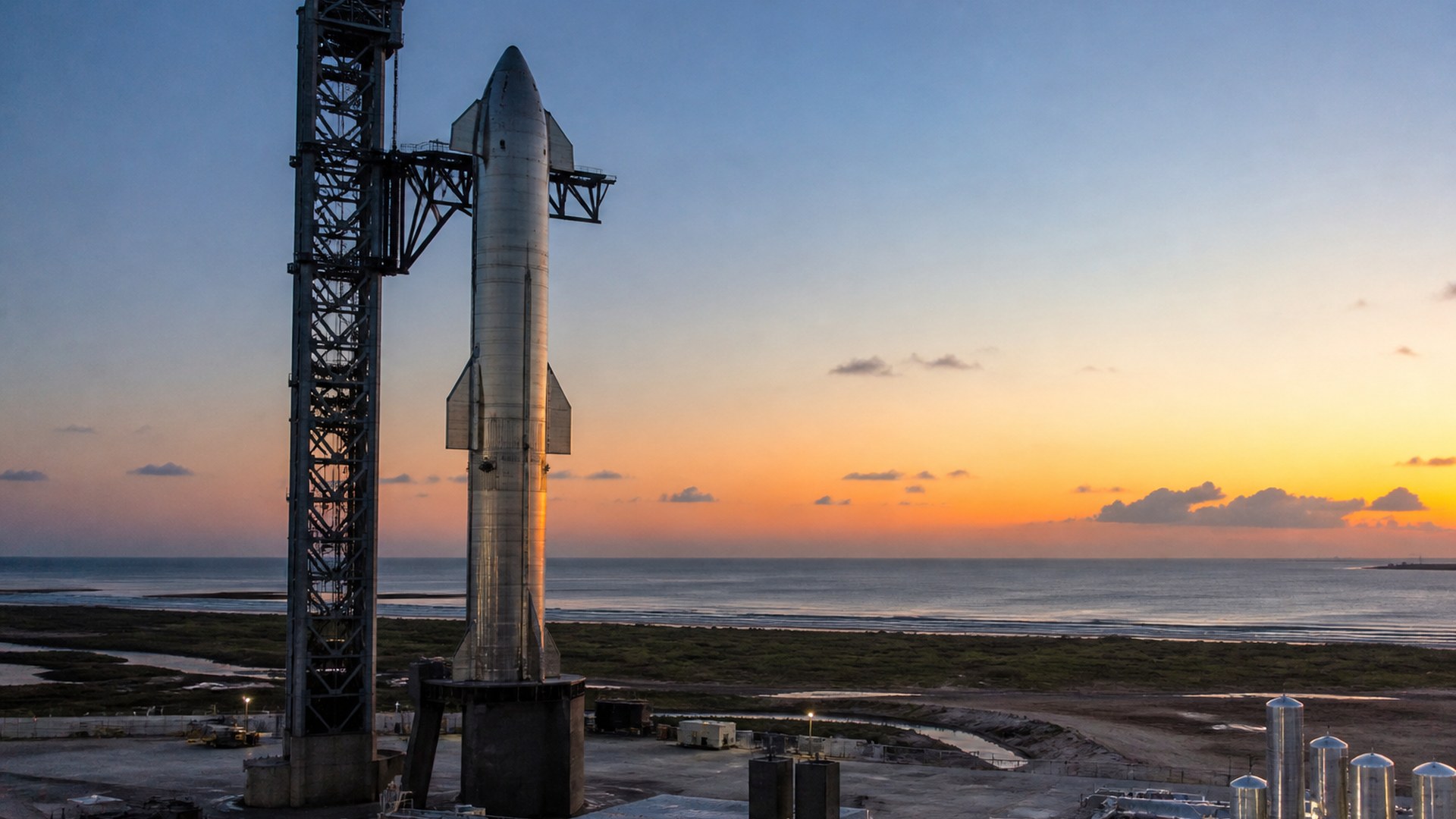
Hardware is lining up behind the filing, and some of it is already on the record. On 28 August SpaceX posted a full-duration 33-engine static fire “with the Super Heavy booster preparing for Flight 14,” two video clips of the plume at Starbase. That burn is Booster 21 on Pad 2. I've already filed that static fire on its own. Ship 41, the upper stage for the same flight, had already completed its own full-duration, about 60-second, six-Raptor static fire on 21 August. Full duration, on this programme, is the length the flight needs from those engines on the stand, held down. It is not a launch. Static fire is not GO.
What Flight 14 is asking for, if the licence and the stack both hold, is the step Flight 13 could not take. Twenty V3s into an operational orbit. Closing the gap between a demonstration dispenser and a constellation insert. Starpath’s read of the same FCC packet put it the same way: the opening of the regulatory window indicates the earliest possible launch date rather than a firm schedule. Starship dates routinely slip. I'm not inventing a T-0 from a radio start date.
Catch language needs the same care. Musk initially floated catching the ship with the Starbase tower on the same flight. He walked that back on 20 August, saying a catch attempt would come “in a few months.” TeslaNorth and KeepTrack both kept the Indian Ocean splashdown as the expected ship end for Flight 14. LookToSpace’s public compile had Booster 21 aimed at a Gulf splashdown rather than the chopsticks. Those are attributed reads of public remarks. They are not a recovered booster on a deck. Rumour and filing stay labelled.
The FAA side of the same week is a different document. On about 2 September the agency posted a Final Tiered Environmental Assessment and Finding of No Significant Impact / Record of Decision for Starship reentry contingency operations in the Pacific Ocean and an additional landing trajectory back to Starbase. That FONSI expands Hawaii and Central Pacific and Southeast Pacific contingency areas, adds a new Northern Pacific Contingency Landing Area for an Eastern Range-to-Starbase trajectory, and covers temporary airspace closures for another reentry path to Boca Chica. The Federal Register notice of availability followed on 4 September. That file is licence-class environmental clearance, not a Flight 14 GO. I'm walking it as its own story. Cross-reference only: the Pacific paper and the FCC STA arrived in the same news week. They are not the same stamp.
Cadence is ordinary nouns. Pad 2 is the active orbital stand at Starbase on the secondary notes already used for the 28 August burn. Pad 1 sits in a longer rebuild. Booster 21 rolled to Pad 2 around 25 August after cryogenic proof work in mid-July. Ship 41 did Massey’s, then payload work toward Mega Bay. A stack photograph isn't on hand yet. Integration, inspections, software for an orbital burn, flight-termination provisions that last longer than a suborbital afternoon — those are the boring steps between a static fire and a licence. Starpath said so in so many words. I'm keeping them.
Metric, because that is how this copy talks. Ship 41 is about 52 metres of stainless upper stage. Booster 21 carries 33 Raptors. V3 downlink on the order of 1 terabit per second per unit in the published specs. Twenty birds is the rough manifest number across TeslaNorth, KeepTrack, and Starpath. Flight 13’s twenty were suborbital. Flight 14’s twenty, if insertion holds, would be the first operational V3 orbit attempt. KeepTrack’s constellation census around 31 August still sat near 12,881 launched, about 11,093 on orbit, about 11,078 working. Those counters move. They are context for why an orbital V3 dispenser matters, not a monument frozen for the day.
Label the layers once more, because the internet will mash them. Filing: FCC experimental STA, signed 21 August, public read 1 September, orbital second stage, window from 15 September 2026. Earnings context: Musk on 4 August, operational Starlink V3 into orbit on the next flight. Hardware: Booster 21 full-duration 33-engine static fire 28 August; Ship 41 six-engine full-duration about 21 August. Environmental: FAA Final Tiered EA and FONSI/ROD about 2 September for Pacific contingency zones — licence-class, not this countdown. Rumour versus paper: tower catch walked back; Indian Ocean splashdown still the expected ship end on the attributed reads; mid-September talk is talk until the FAA clears the stack.
The radios ask for orbit from mid-month. The engines have already spoken on the stand. The Pacific got new contingency lines on the environmental map. None of that is a webcast at T-10. The nouns: Flight 14, Starbase, orbital second stage, Starlink V3, Booster 21, Ship 41, STA not licence, 15 September NET. If the burn holds later, the constellation gets a new class of bird. If the date slips, the filing still said what it said. That is the list.
The paper
Comments
No notes on this story yet.
Sign in to comment