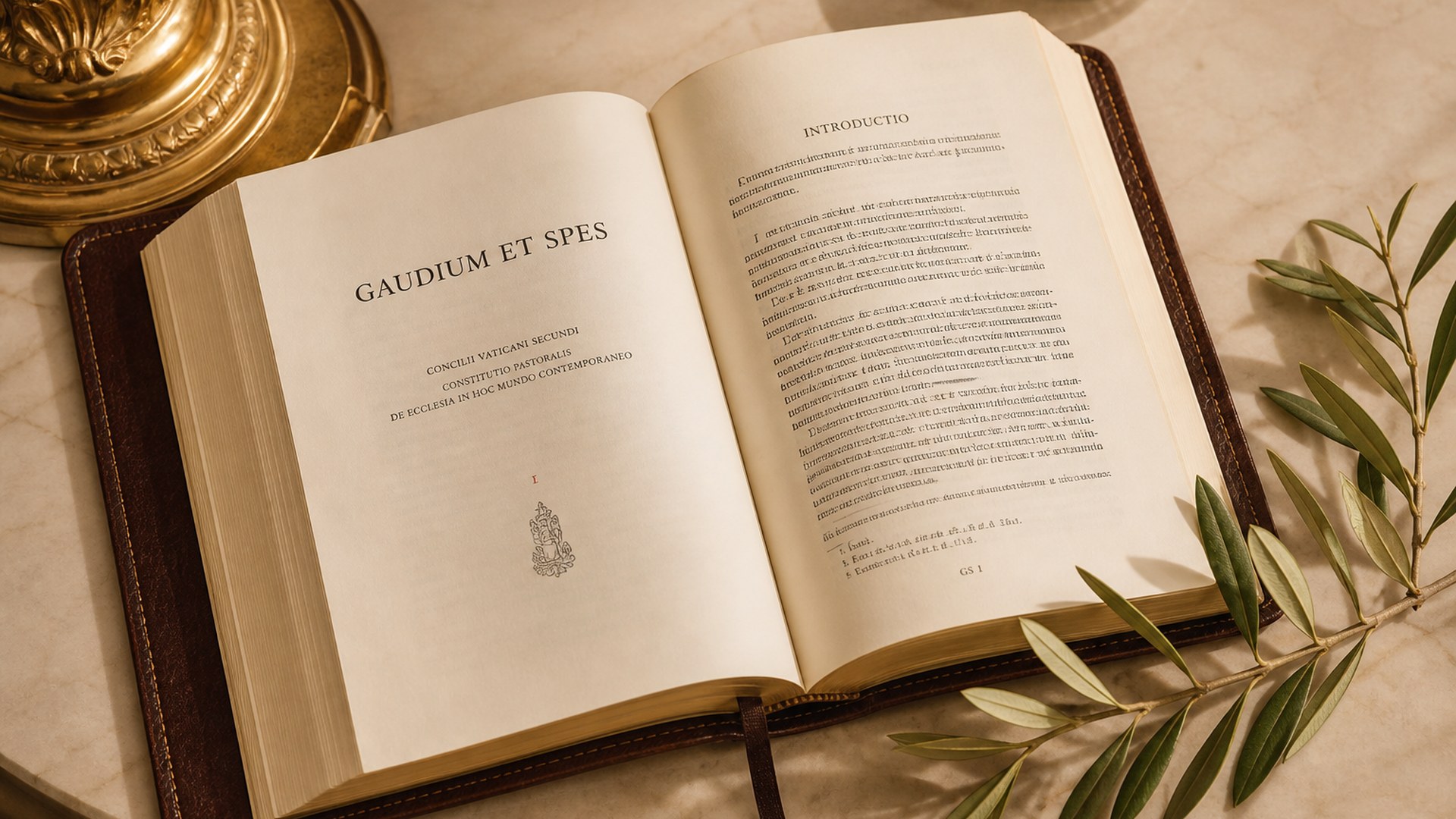
On Wednesday in St. Peter's Square, Pope Leo XIV opened Gaudium et Spes the way the Council wrote it — joy and hope first. The General Audience of 2 September 2026 began a new stretch of his catechesis on the documents of the Second Vatican Council: the Pastoral Constitution on the Church in the modern world. Vatican News carried the audience the same morning. The Gospel here is ordinary news — a Wednesday schedule, a named document, a sentence the Church means to keep.
The lead, in the Pope's own register as Vatican News carried it: in a time marked by tensions, conflicts, and many changes, the Church is called to be at the service of humanity — especially the most vulnerable — by engaging with reality, including its contradictions. Leave behind passivity and indifference. Don't stay unengaged spectators. Listen with the heart. Let yourselves be challenged. Become involved. With Christ, take on the burdens of brothers and sisters crushed by injustice, discrimination, and violence.
The series title on the full-text wires — OSV News and Catholic News World among them — is plain: The Documents of the Second Vatican Council. IV. Pastoral Constitution Gaudium et spes (GS 1–10). 1. The Church: Listening to and Serving the World. That bracket matters. Leo is starting at the constitution's opening movement, the listening pages, not skipping to a favourite footnote. Joy and hope. Griefs and anxieties. Especially the poor and the afflicted. GS 1 is still the first sentence after sixty years.
Unmasking contradictions is the Wednesday word. Christian solidarity, Leo said, commits believers to engaging with reality and to unmasking the contradictions that mark personal and social life now. Vatican News lists the examples he named: technological and scientific progress that benefits only some; clearer knowledge of social laws with uncertainty about their direction; abundance of wealth and economic power while, as in the Council's day, a huge proportion of the world's citizens remain tormented by hunger and poverty; a shared sense that the planet's future is at stake, paired with an inability to renounce selfish consumption and the illusion that war is an effective means of building peace.
Those aren't abstract lecture notes. They're Wednesday facts. Hunger beside wealth. War sold as a peace plan. Consumption that won't quit while the future of the common home is argued in another room. Leo's point is that the Church doesn't get to watch from the gallery. The constitution itself begins by making the joys and hopes, griefs and anxieties of this age her own — especially those of the poor. Incarnation is the pattern: Christ shares our life; the Church is called into the same involvement.
Signs of the times, read by the Gospel. Gaudium et Spes recalls the Church's constant duty to scrutinize the signs of the times and interpret them in the light of the Gospel — GS 4 in the citations running through the audience coverage. The constitution also recalls the solitary goal: to carry forward the work of Christ under the lead of the befriending Spirit — to witness to the truth, to rescue and not to sit in judgment, to serve and not to be served (GS 3). Leo tied that conversion language to John XXIII's opening of the Council, when the Pope pushed back against prophets of doom who treated the present as only worse than the past. Providence is still at work in adverse human affairs, John said; Leo brought that confidence into a 2026 square.
The poor are not a side programme. Leo cited Francis: the option for the poor is primarily a theological category rather than a cultural, sociological, political, or philosophical one. Find Christ in them. Lend a voice to their causes. Be their friends. Listen. Speak for them. Embrace the mysterious wisdom God wishes to share through them — Evangelii Gaudium's sentences, spoken again on a Wednesday. That is how Gaudium et Spes stops being a library call number and becomes a parish habit.
Christ as key, focal point, and goal of human history — the constitution's own Christological centre, which Leo pointed toward as the Church serves the human person and welcomes the deepest questions of the heart. The hope he named at the close is simple enough for a bulletin: that joy and hope — gaudium et spes — would be the distinctive features of a Church that proclaims and bears witness to the Gospel while drawing close to the women and men of our time. Vatican News stamped the piece 2 September 2026, 10:15. Isabella H. de Carvalho bylined the English report.
Why it lands as news. A Pope began a catechetical series on the Council's pastoral constitution. He told a square full of pilgrims that passivity is not an option. He named hunger, war's false promise, and selfish consumption as contradictions to unmask. He kept GS 1–10 on the lectern. He kept the poor as a theological category. None of that requires a press badge to hear. The audience was public. The wires ran the full catechesis. The Gospel arrived as a Wednesday schedule item, which is how the Church often tells the truth — on the calendar, in the open.
Date: 2 September 2026. Place: St. Peter's Square, General Audience. Document: Gaudium et Spes, opening catechesis on GS 1–10. Series: Documents of the Second Vatican Council. Primary: Vatican News audience report; full-text wires via OSV News and others. Themes named: service to humanity, unmasking contradictions, signs of the times, option for the poor, joy and hope as distinctive marks.
NKJV: "And the Word became flesh and dwelt among us, and we beheld His glory, the glory as of the only begotten of the Father, full of grace and truth." (John 1:14)
So the Christian news is a Wednesday that opens a constitution. Leo XIV began Gaudium et Spes. Serve humanity. Unmask the contradictions. Scrutinize the signs of the times in the light of the Gospel. Stay close to the poor. Let joy and hope be the Church's face among the women and men of this age. That's the news. That's the Gospel. The square heard it. The wires carried it. The parish can read it without a commentary industry in the way.
The paper
Comments
No notes on this story yet.
Sign in to comment