
Freight needs a megawatt. Not a destination plug for a family hatchback — a highway-grade MCS bay that can put a megawatt or more into an articulated truck between fatigue breaks. That’s the news from the ARENA/AECOM road-freight file.
Electrifying Road Freight – Pathways to Transition, the AECOM report commissioned by ARENA, puts interstate hauling on megawatt charging systems and stages a national hub build. Fleet EV News walked the numbers: 11.5 to 16 terawatt-hours a year by 2040 depending on uptake. Australian roads can carry electric freight if the hubs land where the semis already stop.
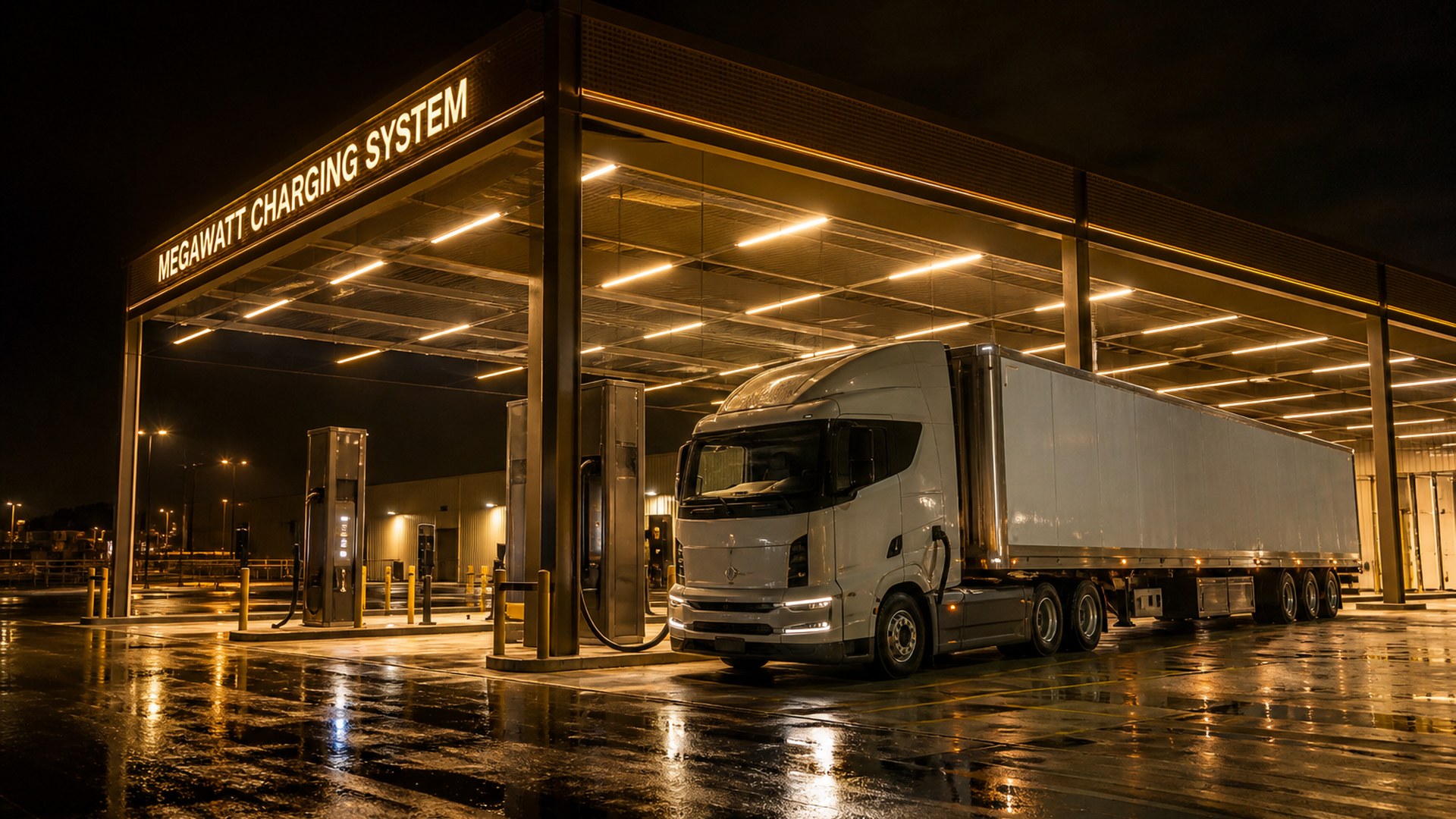
Three use cases, three plug speeds. Urban freight — vans, utes, last-mile — lives on depot AC overnight, 7 to 22 kilowatts, off-peak. Intrastate rigid and medium-duty runs of 200 to 800 kilometres mix depot, destination, and public DC in the 150-to-350-kilowatt band. Interstate articulated sets regularly push past 1,000 kilometres in a shift pattern. For those, AECOM says megawatt charging systems — MCS, one megawatt and up — are essential for fast top-ups along the corridor. Overseas tests already show systems toward 3.75 megawatts. Australia’s freight task does not get to copy-paste Europe’s map, but the connector class is the same idea: minutes that fit a regulated break, not hours that blow a roster.
Energy demand is the grid half of the roads story. Moderate uptake lands around 11.5 TWh a year by 2040. High uptake — full urban BEV penetration, heavy shares of intrastate and a serious interstate slice — lands around 16 TWh. Fleet EV News notes that even the high case is only a few percent on national electricity demand if generation build-out holds. AECOM’s own line is blunt: generation is not the binding constraint. Transmission and distribution — getting high-capacity power to depots, rest stops, and regional hubs — is. “Aligning transmission and distribution networks to ensure power reaches where it is most needed is likely to be the primary future challenge,” the report says. That’s the sentence that matters for the road. A megawatt bay without a feeder is a sculpture.
Staged hubs: up to 165 freight charging locations in the national overview, collocated with ports, roadhouses, and intermodal nodes where possible. ARENA’s blog on the blueprint calls for localised planning on top of that overview — micro-siting against traffic, regional demand, and renewable adjacency. Urban hubs fight for space near substations. Regional hubs may need substation upgrades and new lines. Remote and isolated sites lean on solar, wind, and battery storage when the wires won’t reach. That geography is Australia in one table. You do not electrify the Hume the same way you electrify a Kimberley spur.
ARENA is already putting money behind electric freight trials so the modelling meets rubber. Centurion’s Hazelmere depot in Western Australia with dual-plug chargers. Patrick Terminals’ electric terminal trucks at Fremantle. ANC’s large urban BEV deployment. Team Global Express in Western Sydney. Linfox across three states. Toll at sites nationwide. Zenobe’s Mascot hub with dual-plug bays and second-life stationary storage. Those names are the proof that depot electrification is not theoretical. MCS on the open highway is the harder chapter — the one that turns a national highway into an electrified freight corridor instead of a string of overnight yards.
MCS is pavement policy. A rest stop that cannot accept a B-double’s turning circle is not a freight charger. A bay that cannot hit a megawatt will not reset an articulated battery inside a legal fatigue window. Spacing targets in the Fleet EV News read-through put ultra-fast hubs at about 600 kilometres or less to match top-end BEV truck range — a different maths from the passenger Nullarbor’s 175-to-200-kilometre pattern, because the vehicles and the duty cycles differ. Driver amenities, toilets, food, and a place to park a combination vehicle are part of the charging product. Ignore them and you have built a kilowatt sculpture beside a highway the trucks cannot use.
Who builds it. AECOM’s staged rollout needs government co-funding for non-commercial sites, policy clarity on standards and tariffs, private partnerships among energy companies, fleets, and site hosts, and DNSP cooperation on upgrades. Peak management — overnight depot charge, on-site BESS, rooftop solar, smart scheduling — keeps the megawatt spikes from becoming everyone else’s blackout. None of that is romantic. All of it is how you get from a PDF to a live bay on the Newell or the Pacific.
The numbers in one place. MCS: one megawatt and up, overseas demos toward 3.75. Interstate trip lengths: often past 1,000 kilometres. Hub overview: up to 165 sites. 2040 demand: 11.5–16 TWh. Urban AC: 7–22 kW. Intrastate DC: 150–350 kW. Fatigue-aligned top-ups, not destination-only dreaming. Fleet EV News, ARENA’s electrifying-road-freight blog, and the AECOM knowledge-bank report page carry the spine.
Success on an Australian road looks like this. A driver pulls a combination into a signed freight hub, plugs an MCS cable during a mandated break, and rolls with enough electrons to reach the next staged bay or the destination depot. Ports and intermodals host overnight and turnaround charge so urban and intrastate fleets never fight passenger queues at shopping-centre DC. Remote legs carry solar-plus-storage where the grid is a rumour. The path is staged because the money and the feeders are staged. The path exists because ARENA paid for the map and fleets are already buying trucks.
Family crossings on the Eyre and freight MCS on the Hume are the same national project at different amperages. One closed gaps to about 175–200 kilometres for cars. The other needs megawatt bays and 165 hubs for semis. Both treat the road as an energy corridor. Both fail if maintenance and grid access are afterthoughts.
ARENA. AECOM. Electrifying Road Freight. MCS for articulated interstate trucks. Staged hubs, up to 165. 11.5–16 TWh by 2040. Generation enough; wires the hard part. Trials already rolling at named depots. A printed path for electric freight on Australian roads. Freight needs a megawatt. The report says where to put it.
The paper
Comments
No notes on this story yet.
Sign in to comment