
The object on the stand is the news. At IFA 2026 in Berlin, AMD put a tower on the keynote floor and called it the Threadripper Halo Station — a liquid-cooled workstation built to keep trillion-parameter models locally instead of in somebody else’s cloud. Tom’s Hardware filed the unveil with the inventory that matters: a 96-core Threadripper Pro 9995WX, dual liquid-cooled Instinct MI350P accelerators with a path to four, up to 2 TB of DDR5, and 288 GB of HBM3E on the dual-card show unit, scaling to 576 GB if you fill the four-accelerator sketch. The chassis is the story. No price. No ship date. The metal is the peg.
Call the CPU by its right name before the marketing does. Threadripper Pro 9995WX. Ninety-six Zen 5 cores. One hundred and ninety-two threads. Boost up to 5.4 GHz on the trade sheets. Three hundred and eighty-four megabytes of L3. A 350 W TDP class for the host alone. TechPowerUp’s IFA note, dated 4 September, puts the same Shimada Peak silicon at the heart of the station and reminds you the machine is aimed at one job: run AI models north of a trillion parameters locally, without a WAN dependency for the weights. Jack Huynh, AMD’s SVP and GM of Computing and Graphics, framed it as supercomputer-class compute for individual users and developers. That is the company’s sentence. I’m printing the sockets beside it.
The accelerators are why the tower exists. Each Instinct MI350P is a PCIe-class card with 144 GB of HBM3E. Two cards on the IFA floor give you 288 GB of that fast stack. Four cards — the “path to four” language AMD and Tom’s Hardware both carried — would land 576 GB of HBM3E on one workstation. Bandwidth figures in the TechPowerUp filing put each card’s HBM around 4 TB/s, orders of magnitude above the LPDDR pools on thin AI PCs. Thermal design is not a footnote: each MI350P can draw up to 600 W, and the station cools the accelerators and the Threadripper with liquid loops rather than a screaming rack fan wall. The show unit had two cards. The roadmap slide had four. Don’t confuse the two.
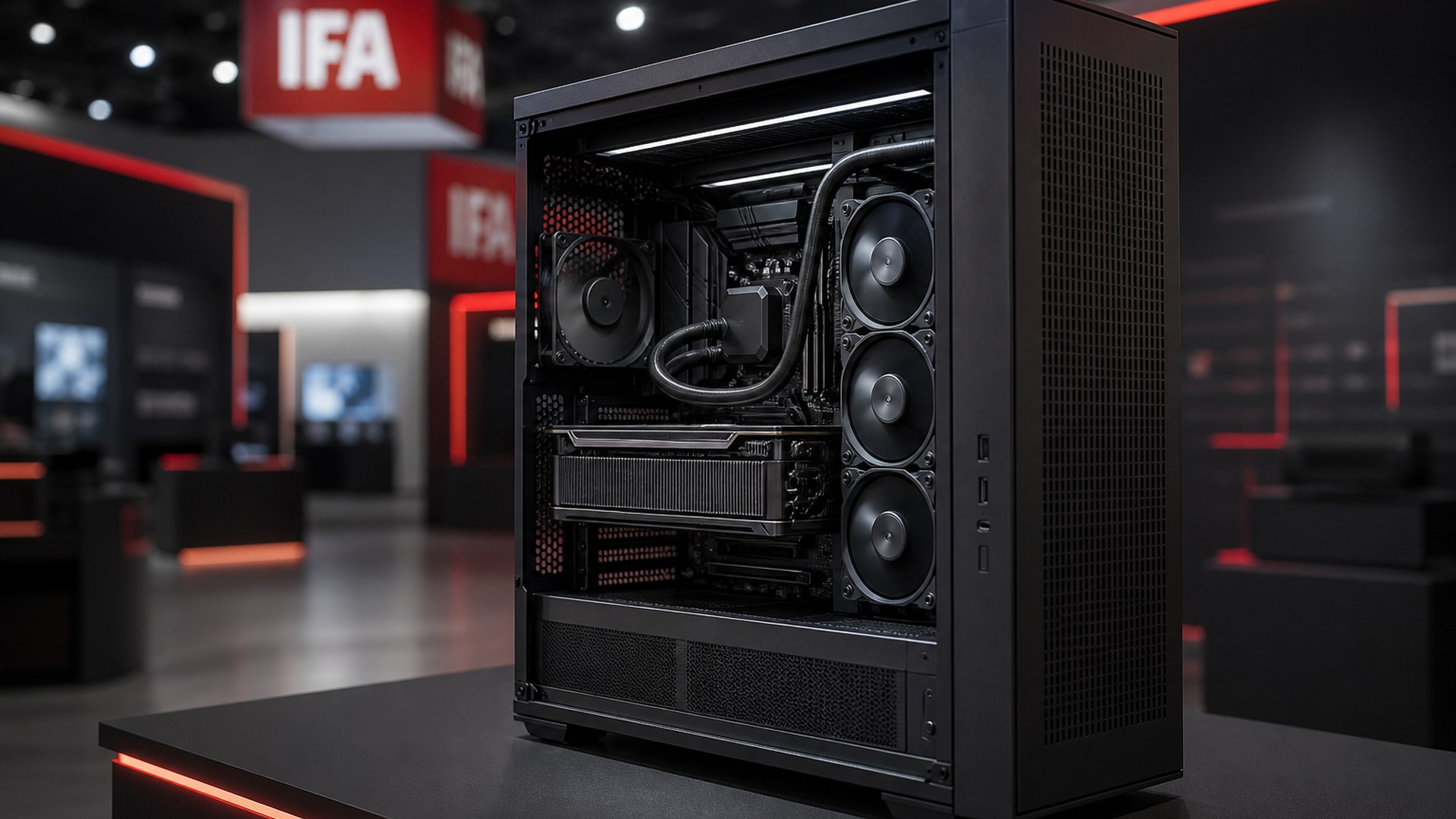
Memory topology is the product. System DDR5 tops out at 2 TB across the Threadripper’s eight-channel class memory subsystem. Accelerator HBM is the working set for the model weights you refuse to page out to a remote cluster. AMD’s claim — and it is a claim until reviewers load real checkpoints — is that this much on-package HBM is enough to hold a trillion-parameter model entirely on-device at the precisions the Instinct stack is built for. The Register’s 4 September write-up walked the same arithmetic and noted that spilling into system memory could stretch further into the multi-trillion open-weight zoo. I’m not inventing a benchmark I haven’t seen. The company put a trillion-parameter sentence on a workstation slide and backed it with hundreds of gigabytes of HBM3E.
What the Halo Station is not: a retail SKU with an MSRP in the keynote. AMD is positioning the box as OEM-built metal, not a direct-from-factory cart add. Complete system specs, availability, and pricing were not announced at IFA — TechPowerUp said so in as many words, and Tom’s Hardware’s filing matches that blank. Analyst guesses about card street prices and Threadripper tray costs are other people’s maths. I’m not inventing a dollar figure for a machine that has not been quoted. Cadence here is the object: a liquid-cooled tower you can point a camera at, with named silicon inside, shown under the Halo Station label.
Name collision watch, because AMD has been busy with Halo nouns. The Threadripper Halo Station is not Strix Halo, and it is not the smaller Ryzen AI Halo mini-workstation story from earlier in the cycle. Heise’s IFA floor note is careful on that point, and you should be too. This is Instinct silicon in a workstation envelope — the first time, on The Register’s telling, that AMD’s Instinct accelerators have been offered in that form factor. Server cards with passive coolers are a different product psychology from AIO liquid loops hanging off a tower a researcher might actually put under a bench. The name is doing branding work. The coolers are doing physics work.
Power is the unromantic limit. Two 600 W-class accelerators plus a 350 W host already ask rude questions of a wall circuit once you add the rest of the box. Four cards at nameplate would be a datacenter conversation wearing a workstation badge. That is likely why the IFA unit showed two. Under-clocked or lower-TBP configs may exist when OEMs ship; AMD has not put those numbers on the public IFA card I’m citing. Power is an engineering boundary, not a gotcha. The fact on the floor is that AMD brought liquid-cooled Instinct into a form factor researchers can imagine owning, instead of only renting by the rack-hour.
Metric, because we run metric. Two terabytes of DDR5. Two hundred and eighty-eight gigabytes of HBM3E on the dual-card show unit. Five hundred and seventy-six gigabytes if the four-accelerator path is real metal. One hundred and forty-four gigabytes per MI350P. Ninety-six host cores. Four terabytes per second of HBM bandwidth per card on the TechPowerUp sheet. Six hundred watts class per accelerator at the top of the TBP range. Those are the countable nouns. Keep them next to the claims, not underneath them.
Who it is for is the other half of the object story. Local AI for labs that cannot or will not ship every weight to a hyperscaler. Media and research groups that want deterministic hardware under their own roof. Developers who need a head node that does not evaporate when a cloud reservation ends. Huynh’s “new class of workstation” line only works if OEMs actually build the chassis, qualify the loops, and put a purchase order path in front of those buyers. AMD showed a prototype path at IFA. The OEMs are the delivery trucks. Names and dates were not on the handout Tom’s Hardware and TechPowerUp worked from.
Compare carefully if you must. NVIDIA’s DGX Station lineage is the obvious rival noun in every comment thread. This is not a bake-off. It is an inventory of what AMD put on the Berlin floor: Threadripper Pro host, Instinct MI350P accelerators, liquid cooling, HBM measured in hundreds of gigabytes, a trillion-parameter claim, and a blank where the price and the day-one SKU list should be. Speculation about 450 W versus 600 W operating points belongs in a follow-up when a partner sheet exists. Speculation about street prices belongs in a forum, not here.
Software posture is implied, not demonstrated, in the IFA coverage I’m using. Instinct stacks live in AMD’s ROCm world; a workstation that exists to run local trillion-parameter models only matters if the framework story lands on that same box. AMD did not, in the Tom’s Hardware and TechPowerUp primaries, publish a day-one model zoo or a latency chart from the Halo Station itself. So you write what you have: silicon, memory, cooling, claim. You leave the tokens-per-second table for the review units.
The dates line up. IFA 2026 opening keynote window: about 4 September. Tom’s Hardware unveil filing: same news cycle. TechPowerUp on-the-ground note: 4 September. The Register: 4 September, with a soft “next year” availability murmur that is still not a day or a price. On Sunday 6 September 2026 this is a workstation-as-object story. The chassis has a name. The CPU has a name. The accelerators have a name and a headcount. The HBM has a dual-card number and a four-card ceiling. The purchase order does not have a number yet.
So here’s the lead. AMD Threadripper Halo Station at IFA: 96-core Threadripper Pro 9995WX, dual liquid-cooled Instinct MI350P with a path to four, up to 2 TB DDR5, 288 GB HBM3E shown and 576 GB sketched, trillion-parameter local-model claim, OEM path, no price, no firm date. Tom’s Hardware carries the unveil inventory. I’m not inventing a sticker. The news is that Instinct showed up in a tower you can walk around, with enough HBM on the slide to make the trillion-parameter sentence sound like engineering instead of theatre. That is a workstation story. Treat it like one.
The paper
Comments
No notes on this story yet.
Sign in to comment