
They went outside for the jobs, not the adjective. On Tuesday, 1 September 2026, NASA astronaut Jessica Meir and ESA astronaut Sophie Adenot finished U.S. spacewalk 99 at 3:29 p.m. Eastern after 6 hours and 49 minutes on the International Space Station’s hull. NASA’s station blog posted the list the same afternoon: new retroreflector on Harmony’s forward port, high-definition camera swap on the truss, exterior swab for microorganisms, partial jumper-cable work, and the start of prep for an Alpha Magnetic Spectrometer radiator replacement later. Sixth all-female spacewalk in the record books. The tasks are the lead.
Battery power at the suits, then the clock. The duo set battery power and began the extravehicular activity at 8:40 a.m. Eastern out of Quest — about ten minutes off the printed plan, still a clean egress. Meir and Adenot split toward separate worksites. Navigation aid first. Camera next. Science swab and jumpers in the middle hours. AMS metal toward the end. When the timeline slipped, Mission Control deferred what could wait. That is how a good EVA reads when you strip the romance out: a checklist with a hatch at both ends.
The retroreflector is a docking sentence in hardware. NASA’s blog calls it a new retroflector — their spelling — on the forward port of Harmony, installed to support spacecraft navigation during rendezvous and docking. Trade coverage said the unit being replaced had taken thruster residue; the point for readers is simpler. Visiting vehicles need a clean optical target. Meir and Adenot put a fresh one on the port that sees arrivals. Harmony forward is not a decorative address. It is where traffic meets the American segment.
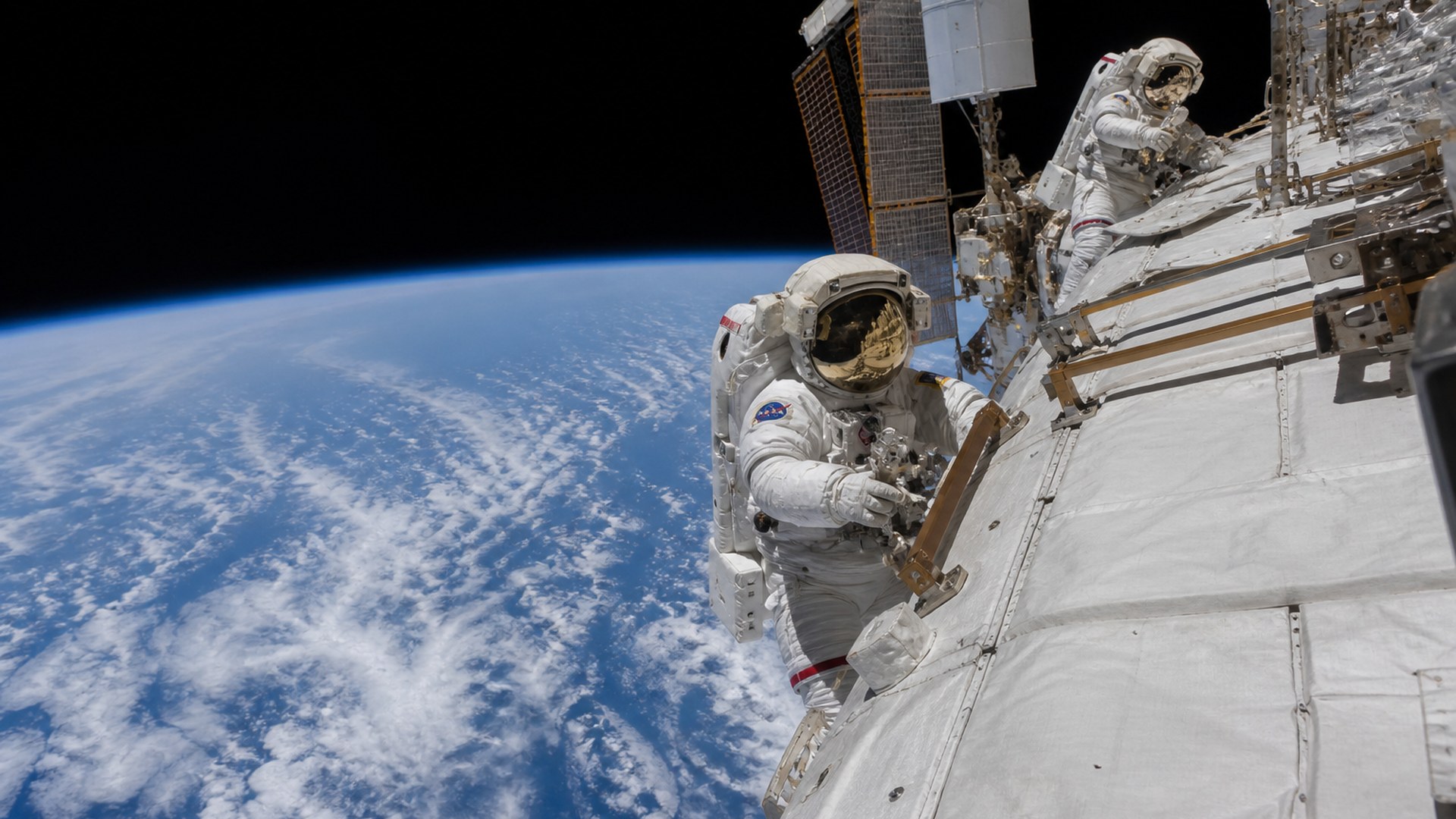
The camera job lived on the truss. A failed high-definition camera came off; a spare went on. Adenot rode Canadarm2 for that reach on ESA’s account of the day. External video is how ground teams and crews watch the station’s skin. Replacing a dead imager is maintenance you can explain to anyone who has ever swapped a security camera on a warehouse wall, except the wall is moving at orbital velocity and your gloves are pressurised. Six hours and forty-nine minutes is a long time to keep that kind of work tidy.
The swab is science you can hold in a bag. Adenot collected exterior samples near the airlock and from her gloves for the MicroOrganisms experiment — NASA’s check on whether life-support vents release microbes and how far they travel along the hull. ESA’s write-up is explicit that she went back to the airlock mid-EVA for the sample kit. It is a small task on a timeline and a large question for closed-loop habitats. You do not answer it from a whiteboard. You answer it with a wipe on metal that has seen vacuum.
Jumper cables were the electrical half-finished sentence. The crew partially completed installs meant to improve power and data routing. As the clock ran long, Mission Control moved the remaining jumper work and other noncritical items to a later spacewalk. Partial is not failure on an EVA sheet. Partial is triage. The same deferral logic hit guide-stud work for the AMS radiator replacement: engineers want a plan before the next crew finishes what Tuesday started.
AMS is the Alpha Magnetic Spectrometer, the cosmic-particle instrument on the station’s exterior. Meir began preparatory work for a future swap of its heat-rejecting radiator and relocated a portable foot restraint for the follow-on EVA. She also reported bolts that fought back — resistance, metal shavings in holes — while working that hardware, according to contemporaneous reporting. NASA’s blog is plainer: started radiator-prep, deferred remaining guide studs. Both readings fit. The spectrometer stays on the board for another day outside.
Suited trouble showed up late. Adenot lost mobility in her left shoulder joint. Meir inspected and judged that a glove-heater harness was likely catching in the joint. Unzipping eased it before ingress. Mission Control had Adenot hold position until Meir could accompany her back; Meir closed the hatch on the way in. Caution, not drama. Adenot had flagged similar shoulder stiffness on an earlier walk this month. The suit is a machine. Machines snag. Crews fix what they can and bring the rest inside.
Numbers that belong beside the names. U.S. EVA 99. Meir’s seventh spacewalk; Adenot’s third. Meir now third among NASA women for career spacewalk count, behind Peggy Whitson at ten and Suni Williams at nine. Two hundred and eighty-fourth spacewalk in support of station assembly, maintenance, and upgrades. Seventh U.S. walk of the year on Space.com’s tally; fifth for Expedition 75. Sixth all-female EVA in history. Meir is station commander on this increment. Adenot flies for ESA. Those are the ledger lines NASA and ESA already printed.
Primary citations stay tight. NASA’s “ESA, NASA Astronauts Complete Navigation and Science Spacewalk Outside Station,” 1 September 2026, 3:58 p.m. post time on the blog. ESA’s Adenot note the next day for the European framing and the sample-kit detail. Space.com for the all-female count and the 8:40 start. I'm not inventing torque values or a missing bolt part number. Concrete tasks are enough: reflector, camera, swab, partial jumpers, AMS prep, 6 h 49 m, Quest to Quest.
Translate the duration into something you can feel. Six hours and forty-nine minutes is a long clinic shift in a suit that fights every shoulder rotation. Tools tether. Bolts complain. Foot restraints become furniture. Meir’s AMS minutes and Adenot’s sample run are not cinematic because cinema skips the torque. The NASA blog’s tone is the right one: installed, replaced, completed, partially completed, started, deferred. Verbs you can audit against a future EVA that finishes the jumpers and the guide studs.
Expedition 75’s broader crew sheet is background, not decoration. Meir as commander means the person on the end of the tether also owns the day’s station priorities. Adenot’s third walk in a tight window — ESA notes three EVAs in about fifteen days and a cumulative 19 hours 42 minutes for her — is a European operations tempo story as much as a hull story. None of that changes the task list. It explains why Mission Control was willing to bank unfinished electrical work rather than lean on a sticky shoulder for one more connector.
All-female is a historical count, not the reason they were outside. Christina Koch and Jessica Meir opened that ledger years ago; this was the sixth time the two people on the U.S. tether were both women. Note it once, accurately, then return to Harmony’s port and the truss camera. The job is the same either way: say what was bolted, what was bagged, what was deferred, and how long the hatch was open. 8:40 to 15:29 Eastern. Quest to Quest. Reflector, camera, swab, partial jumpers, AMS prep. That is the hull.
So Sunday’s story is a hull story. Meir and Adenot on the outside for nearly seven hours. Harmony forward got its navigation mirror. The truss got its camera. The microorganism bag got its wipe. Cables and radiator studs wait for another sunrise. Sixth time the EVA roster was two women and no one else. Where it is true: the critical path got done, the suit snag got managed, and the station kept its appointments with the next docking and the next science day. The work does not show from the ground. The blog does. The tasks stand.
The paper
Comments
No notes on this story yet.
Sign in to comment