
You can plan Adelaide to Perth in an EV. Roughly 2700 kilometres on the Eyre Highway. As of 2026, charger spacing is generally under 200 km the whole way, with one longer stretch around 260 km between Mundrabilla and Nullarbor. EV Roadside's Adelaide-to-Perth guide is the map I'm working from. The Driven's June 2026 network file backs the same picture: after WA EV Network and RAA Charge closed the remote gaps in 2024–25, the Nullarbor no longer has a gap larger than about 175 km on their fast-charger route measure.
Three networks cover the crossing. South Australia runs on RAA Charge. The Nullarbor roadhouses and the Western Australian leg sit on the WA EV Network — Synergy and Horizon Power, completed January 2025 on EV Roadside's reading. NRMA put a fast charger at Nullarbor itself, about 180 kW DC. CCS2 for DC. Type 2 for slower AC. Bring your own Type 2 cable if you want the AC fallback. Walk the method slowly. Remote Australia still punishes optimism.
Start with the distance, not the sticker range. Two thousand seven hundred kilometres is a multi-day drive even in a petrol car. In an EV you charge often enough that the calendar matters more than a single heroic overnight push. EV Roadside's planning estimate for a typical 60 kWh pack — leave at about 90 percent, arrive with about 15 percent, charge to about 80 percent on the road — lands around eleven charging stops. Treat that as a sketch. Highway speeds, heat, and hills cut range. Dashboard optimism is not a plan.
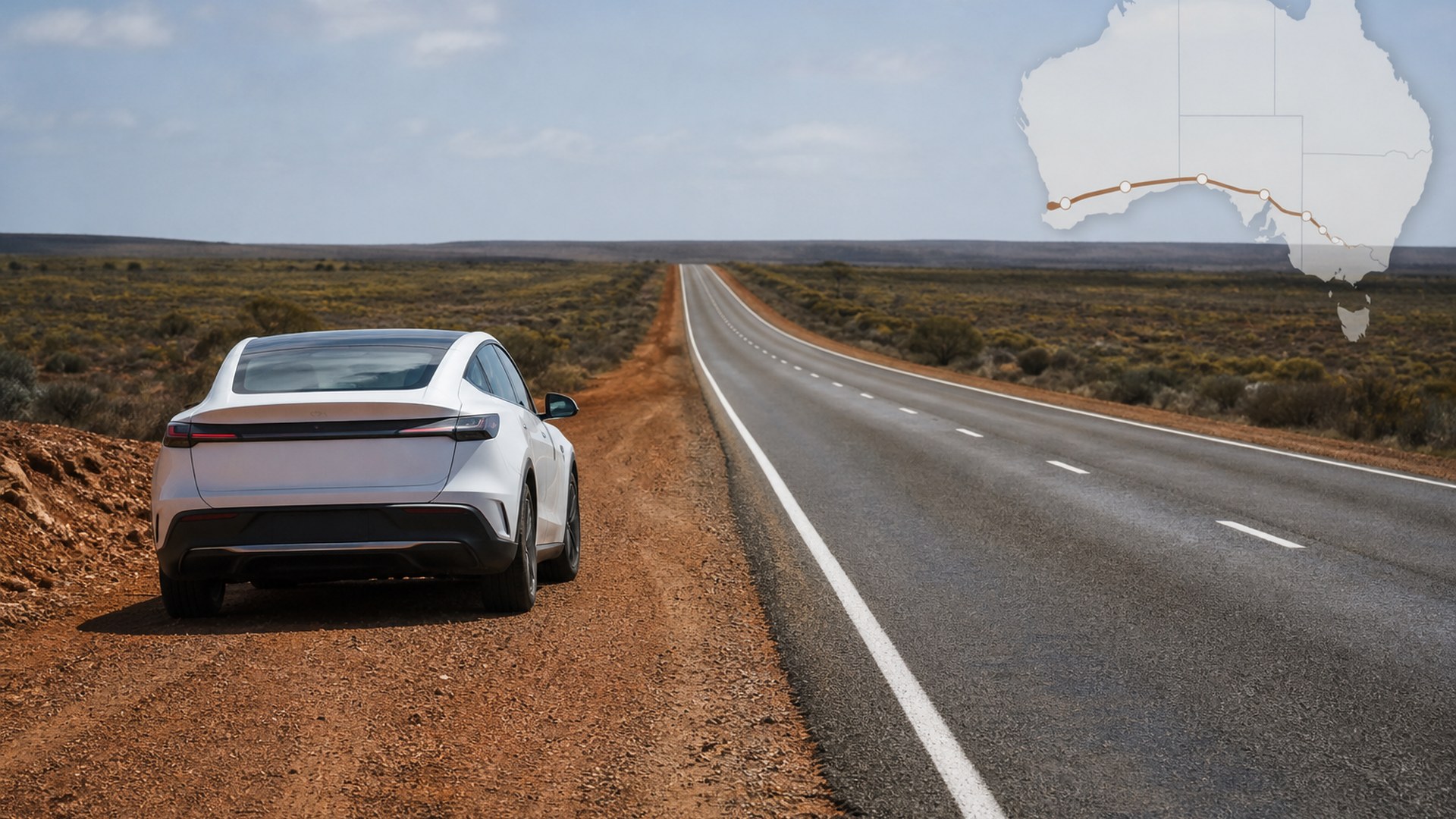
Confirm the far-end charger before you leave each stop. That is the whole craft in one line. With gaps generally under 200 km, the danger isn't the empty stretch between towns. The danger is arriving at a dead fast charger with no margin and no Plan B. Check live status the day before each leg — PlugShare is the habit EV Roadside and The Driven both keep naming. Installed hardware is not a promise it's online today.
South Australia, east to west on the Eyre Peninsula and out to the border: Port Augusta, Kimba, Wudinna, Streaky Bay, Poochera on RAA Charge, mostly 60–200 kW DC with some 7 kW AC. Ceduna's 150 kW site, opened February 2024, and Yalata about 200 km west of Ceduna closed the old 480 km Ceduna-to-Border-Village black spot. Yalata is off-grid and can behave closer to 25 kW when the site is sharing or constrained. Write that down before you romanticise a 50 kW label.
The crossing itself: Border Village on the WA EV Network at about 50 kW DC. Nullarbor on NRMA at about 180 kW. Then Mundrabilla, Madura, Cocklebiddy, Caiguna, Balladonia — WA EV Network and community sites, typically 50 kW DC plus ~20 kW backup units. EV Roadside notes that through early 2026 some of the most reliable chargers on the route were those modest community DC units. Slow can still be honest.
Western Australia toward Perth: Norseman, Coolgardie or Kalgoorlie, Southern Cross, Merredin, Northam on the WA EV Network — 75–150 kW CCS2 with 7 kW AC backup. Dual-outlet DC at many WA EV Network sites means two cars can charge at once when the site is healthy. The network spans dozens of locations from the SA border through the state's north. On this crossing you only need the Eyre-to-Perth spine.
Reliability is the second lesson. Many Nullarbor chargers run off-grid on solar, battery, and diesel. Through 2026, first-hand reports collected by EV Roadside, the Australian Electric Vehicle Association, and The Driven describe outages, blackouts, shared charging that slows both cars, and sites knocked offline for weeks. ABC Goldfields filed the vulnerability story in March 2026: Horizon Power's remote Eyre Highway stations, 50 kW labels that sometimes delivered far less, long waits, and maintenance gaps. The Driven's June canola-oil rescue piece at Mundrabilla is the same weather system — a Biofil unit standing in when the official network wasn't enough. I'm not scaring you off the trip. I'm telling you the map and the maintenance log are different documents.
Plan B is not optional. When a fast charger is down, slower AC or 3-phase at roadhouses and caravan parks is how people finish the day. Carry the cable. Know which roadhouses will let you plug in. AEVA and community DC units are part of that fallback set. A long AC top-up adds hours. Hours are cheaper than a flat battery between Eucla and the next working site. The Driven's April 2026 "must-do's" piece puts it bluntly: plan B for every rural charger, because you'll meet non-functioning ones, and the next working stop can still be 150 km away once a site fails.
Apps you actually open: PlugShare for live status and comments. Chargefox, NRMA, and Tesla where they apply. A Better Route Planner if you like a scripted itinerary. Don't treat any single network app as gospel on the Nullarbor. Cross-check. Screenshot the green status before you leave coffee.
Heat. Summer crossings cook packs and drivers. Thermal throttling slows charging. Air-conditioning eats kilometres. If you can choose, cooler months are kinder. Don't plan to the optimistic winter number you saw on a YouTube run filmed at dawn. Water, a charged phone, and a schedule that assumes delays are part of the kit. Mobile coverage is patchy to absent between towns. Tell someone your legs for the day.
If you do stop with an empty pack: get safely off the road, stay with the vehicle, conserve phone and water. Call roadside assistance — 13 11 11 reaches RAA in South Australia and RAC in Western Australia. Say it's an EV so they send a flatbed. Out here a tow or mobile top-up can be hours away. Roadhouse staff often know which local AC or 3-phase options still work. Before you leave home, confirm your cover handles out-of-charge events and check the tow-distance limit. A Nullarbor tow is long and expensive.
Metric sheet for the notebook. Route: Adelaide–Perth via Eyre Highway A1, about 2700 km. Charger spacing: generally under 200 km; one stretch about 260 km Mundrabilla–Nullarbor; The Driven's June 2026 route measure: no Nullarbor gap larger than about 175 km. Networks: RAA Charge (SA), WA EV Network (Synergy/Horizon Power, completed January 2025), NRMA at Nullarbor. Typical mainstream EV with around 400 km of range can cross with planning. Primary maps: EV Roadside Adelaide-to-Perth trip guide; The Driven / EV Roadside June 2026 national map. Checked Sunday 6 September 2026.
The Driven's June story also reminds you what the Nullarbor win does not fix. Plenty of WA and SA public chargers are still AC-only — fine overnight, useless when you need range in an hour. Single-network dependence in some states is a reliability risk when that network blinks. On this crossing you already carry three network names and a Plan B. Keep that habit even after the highway "proved" itself electric.
I'm not selling you a dare. Here's the method: map the networks, verify each far-end charger live, leave with margin, carry AC fallback, respect heat, know the roadside number. The Nullarbor is crossable in an EV in 2026. The people who do it cleanly treat the gap figures as homework and the outage reports as weather. That's the plan. Drive patient. Charge patient. Arrive with a story about the horizon, not about a tow.
The paper
Comments
No notes on this story yet.
Sign in to comment