
The sky keeps a schedule. On Tuesday, 1 September 2026, NASA’s Nancy Grace Roman team powered the Coronagraph Instrument from 7:27 a.m. to 8:22 a.m. Eastern — fifty-five minutes on the clock, then a monthslong quiet of calibrations. The Goddard blog posted the same morning: planet imager on, science pictures still later. First images remain pointed at early 2027. Three-month commissioning sits between this switch and that release. You do not get the sky by wishing. You get it by naming the next hour.
Two deployments already ticked before the power pins. High-gain antenna: about four minutes of motion, done at 2:03 p.m. Eastern on Monday, 31 August. Aperture cover — the visor: about eight minutes, done at 6:05 a.m. Eastern on Tuesday, 1 September. NASA measured the dish at 5.6 feet across, 24 pounds, carbon composite. In metric that is 1.7 metres and about 11 kilograms. Antenna Monday. Visor before breakfast Tuesday. Coronagraph in the next window. The machine is waking in order, not in a rush.
A coronagraph is a schedule written in glass and mirrors. NASA’s sentence is plain: block starlight to view planets and dusty disks around nearby stars. Optics, masks, self-flexing mirrors, sensors. The glare is the enemy. The faint reflected light is the prize. The agency wants older, colder giants in closer orbits than the hot young super-Jupiters direct imaging has mostly shown so far. That claim is on the 1 September power-on post. It is a technology demonstration with a calendar attached, not a forever stare.
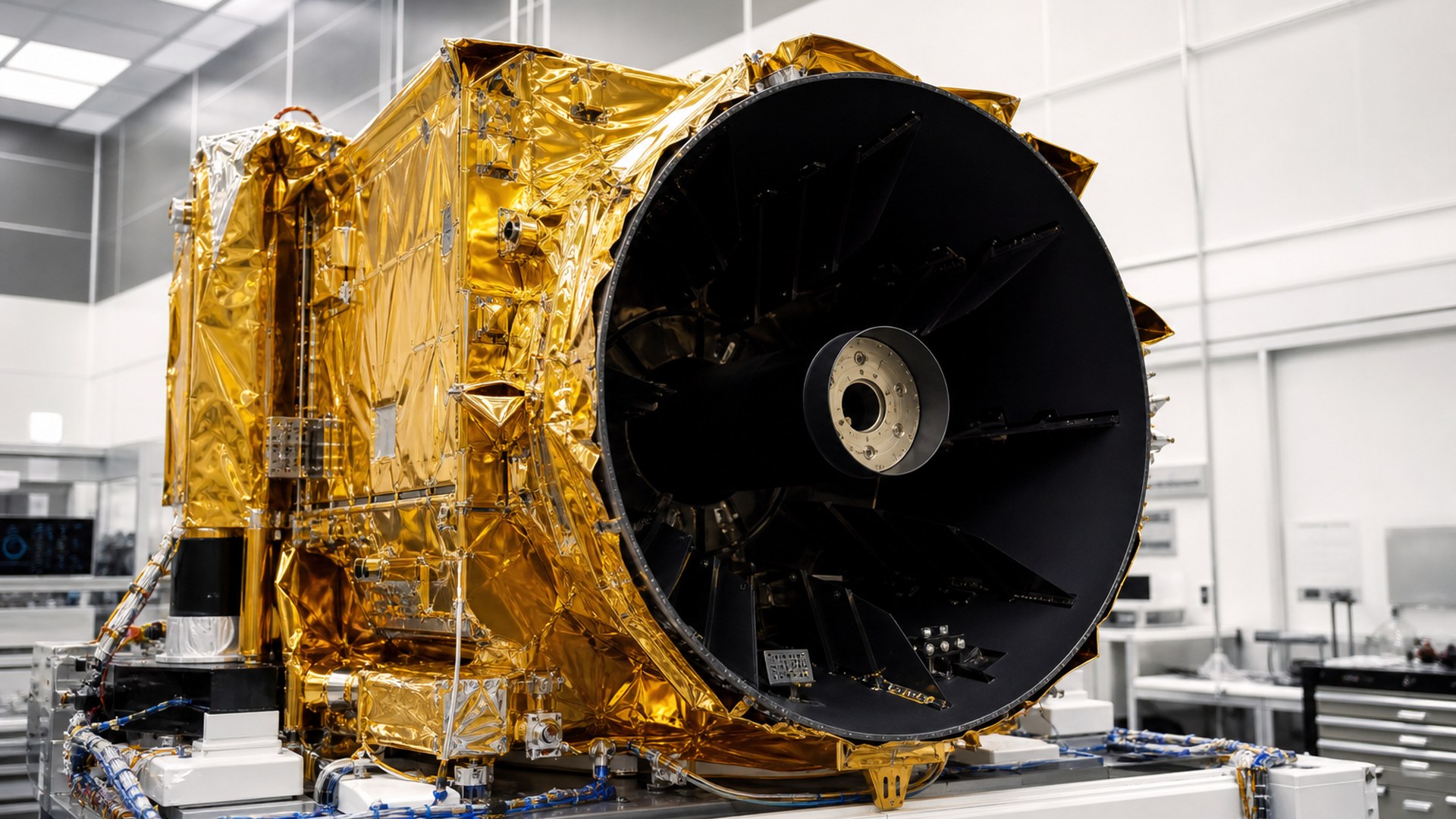
How much sky time the coronagraph gets is itself a number. NASA says the team will run pre-planned observations totalling three months, spread across the mission’s first year-and-a-half of operations. Three months of looking, not three months of continuous staring from day one. Commissioning is about three months for the observatory as a whole. Inside that envelope the coronagraph takes power, then alignment, then thermal settling, then tests. The Wide Field Instrument — the survey camera — is listed to power on a couple of weeks after the coronagraph. Both instruments share the same commissioning runway. First public images early 2027. Those are the published beats. I'm not inventing a first-light date inside that window.
The antenna is how the schedule talks to Earth. Dual-band: commands and health on one frequency, science downlink on another at up to 500 megabits per second. Ground stations in New Mexico, Australia, and Japan, spaced so the link can hold. Highest data volume of any NASA astrophysics mission so far, on the agency’s own comparison. A 24-pound dish carrying that load is the kind of mass budget sentence flight engineers like. The visor’s job is simpler and just as timed: keep unwanted light out of the barrel so faint signals stay measurable. Three booms, electronic triggers, eight minutes. Done before the coronagraph sequence began.
What Tuesday did not do is open the survey. Dark-energy mapping, microlensing yields, the wide infrared stare — those verbs belong to a calibrated observatory on station, not to a fifty-five-minute power-on. L2 is still the neighbourhood the cruise is aiming for; cruise notes sit elsewhere, and I won't recut them here. The point today is the instrument clock. Power confirmed. Communication with the spacecraft confirmed. Mechanisms, detectors, and optics still have to prove themselves in the months that follow. NASA’s own language treats the first success as electrical and conversational, not photometric.
Read the hours the way a night-shift astronomer reads a log. 31 August, 14:03 Eastern: dish locked. 1 September, 06:05: visor up. 07:27 to 08:22: coronagraph alive. Sometime in the next fortnight: Wide Field Instrument. Then the long middle of commissioning — focus, alignment, flat fields, the boring excellence that makes early-2027 pictures worth releasing. Habitable Worlds Observatory is the later idea this hardware is meant to teach. Roman’s coronagraph is not billed as an Earth-twin camera. Jupiter-class steps in visible light are the demonstration. The schedule is honest about that.
Goddard manages the observatory. JPL holds the coronagraph. Those institutional lines are already on NASA’s public pages; I'm not turning them into a credits roll. What belongs here is the cadence: deploy, cover, power, commission, image. Positive news where it is true — and it is true that a named planet-imaging instrument drew power on a named morning and entered its calibration season on time with the blogs. Ashley Balzer’s Goddard posts on 31 August and 1 September are the citations. Antenna-and-visor note. Planet-imager note. Same mission day cluster.
You can hold the excitement without stealing from next year. A live coronagraph is not a gallery. It is a permission slip for the work that makes a gallery possible. The sky will still be there in early 2027. The question for September 2026 is whether the hardware kept its appointments. On the public record, it did. Fifty-five minutes. Two prior deployments. Three months of commissioning ahead. First images still on the far side of that work. Call it schedule, not spectacle.
Commissioning is a verb with sub-verbs. After power comes checkout of mechanisms that have been locked since Florida. Then detector bias and darks. Then the deformable mirrors that give the coronagraph its self-flexing authority over speckles. Then end-to-end alignments against stars that are bright on purpose, so the team can measure how hard the instrument can dig into the glare. None of that is “first light” in the public-gallery sense. All of it is why early 2027 is still the honest image date on NASA’s antenna post. Rushing a pretty picture would steal from the survey the Wide Field Instrument is meant to run for years.
Australia sits on the downlink map. One of the three ground stations NASA named for Roman’s high-rate path is there. When the dish at 500 megabits per second starts moving survey volumes, some of those bits will land on Australian antennas before they become archives. That is not local colour for its own sake. It is why a Greenbelt blog timestamp can sit on a wire here without pretending the telescope is overhead. The schedule is planetary. The ground segment is already written that way.
Keep the coronagraph’s ambition sized to NASA’s own words. Direct images of giant planets and dusty disks in visible light. A technology path toward missions that might one day try Earth-like worlds. Three observing months in the first eighteen. Not a rewrite of exoplanet statistics on Tuesday afternoon. The positive fact is narrower: the planet imager took power on time, after the dish and the visor took their minutes on time, and the commissioning calendar still matches the blogs. That is how you report a living instrument without stealing next year’s sky.
Sunday 6 September: the coronagraph is alive. 7:27 to 8:22 a.m. Eastern on the first. Dish at 5.6 feet and 24 pounds, set on 31 August. Visor at 06:05 on the first. Commissioning measured in months. Pictures aimed at early 2027. NASA Roman blogs. Just the next named hour on a spacecraft that is waking the way flight directors prefer — one switch, then the next, then the quiet labour that turns power into photons you can publish.
The paper
Comments
No notes on this story yet.
Sign in to comment