Austin can hail the two-seater. On 3 September 2026 Tesla put Cybercab into commercial Robotaxi app rides after an invite-only product night — purpose-built, two seats, no steering wheel, no pedals. Riders can call the car that was designed for the fare.
Same day, NHTSA opened Open Audit Query AQ26002 covering an estimated 1,000 Cybercab vehicles and Tesla's FMVSS certification process. That is a second-graf fact, not the lede. Forty-five Texas-registered Cybercabs remain valid context from the TxMCCS book. I'm not inventing fleet size or fares.
I'm keeping the bias honest and positive where the facts allow. The product night happened. The app path opened for Cybercab in Austin. Electrek, AP, Engadget, and others filed the 3 September commercial start. Tesla framed the car as the vehicle with no wheel and no pedals. Guests rode. Then the Robotaxi app became the public door for more riders in the geofence Tesla is running in Austin.
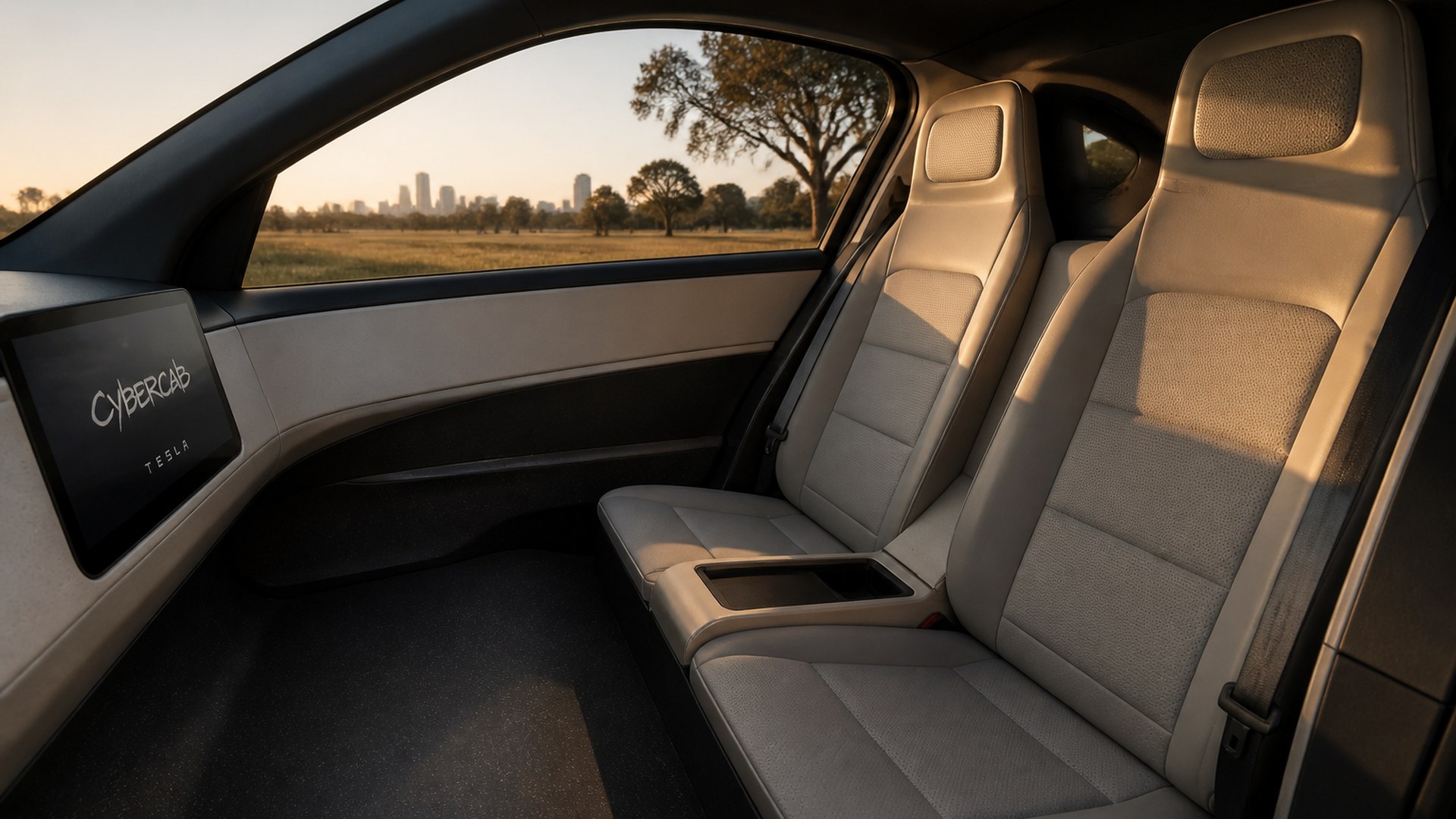
What the car is: two seats on a bench, a big centre screen, trunk space for bags, unsupervised commercial intent. What it is not, on the evidence I'll use: a public retail sale to anyone who wants a driveway Cybercab tomorrow. Engadget noted Tesla is offering Cybercab rides through the Robotaxi app and that, for now, availability and party size shape what a rider gets. I'm not printing a fare table Tesla has not put on the record.
Texas context stays tight. Tesla Robotaxi, LLC already listed forty-five purpose-built 2026 Cybercabs on the Texas Motor Carrier Credentialing System at the end of August. VINs in the 5YJA block. That registration story already ran under its own heading. Tonight is the product night and the hail. Forty-five on the book is the legal roster that made commercial operation possible under Senate Bill 2807. It is not a claim that forty-five cars are all taking paid trips every hour.
NHTSA's audit is the federal footnote you have to carry. Electrek, 4 September, reported AQ26002 from the Office of Defects Investigation, opened 3 September, prompted by public information, covering an estimated one thousand Cybercabs. The agency is examining the process and technical data Tesla used when it certified the Cybercab. Tesla told NHTSA it certified compliance with all applicable Federal Motor Vehicle Safety Standards and plans to expand deployment gradually. NHTSA wants to understand how far that certification rested on determinations that certain FMVSS do not apply to a vehicle without conventional driver controls.
Self-certification is the American system. Automakers certify; NHTSA can audit afterward. Cybercab has no steering wheel, no pedals, and, on Electrek's read of the filing, no mirrors in the conventional sense the old standards assume. That is why the audit exists. It is not, on present filings, a stop-work order. Riders in Austin can still call the car. I'm stating both sentences.
Positive product truth: the purpose-built robotaxi is no longer only a stage prop from 2024's We, Robot night. It is on public roads in Austin with passengers who opened the Robotaxi app. That is a real step for unsupervised commercial hardware. Model Y robotaxis already carried the network. Cybercab is the vehicle Tesla built without the human controls. Hailing it is the story worth putting on the air.
Sources stay careful. Electrek covered the commercial launch and the same-day audit. AP described dozens of steering-wheel-free Cybercabs on Austin streets on 3 September and the invite-only character of the evening. Engadget said Cybercab rides are offered through the Robotaxi app on iOS and Android, with Cybercab appearing first in Austin even as the wider Robotaxi map lists other cities for the service family. Motley Fool and other market outlets will chase the share price; I'm chasing the product object. I'm not inventing a city-wide unsupervised promise beyond what Tesla has geofenced, a fare, or a count of cars in the app at this hour.
Metric where it helps. I'm not inventing a battery kilowatt-hour for Cybercab here because the verified pegs for tonight are seats, controls, app, audit number, and the Texas roster. Two seats. Zero driver controls for the passenger. Austin. Three September. AQ26002. About one thousand vehicles in the audit's estimated scope. Forty-five on the Texas commercial book as prior context.
How to talk the night without turning it into a roast. Invite-only first. Then broader app access. Electrek called the staged reveal a nothing-burger on spectacle and still filed the commercial start as real. That split is useful. Spectacle is not the product. The hail button is the product. If a rider in Austin can request a Cybercab through Robotaxi, the two-seater has crossed from factory and campus rides into the service people already use for Model Y trips.
Keep the other Tesla weeks out of the lede. Dallas geofence expansions are a different object. Semi factory inauguration is a different object. Tonight's object is the Austin hail of the two-seater. You can call the purpose-built car. The audit is open. The Texas book still shows forty-five. I'm not inventing the rest.
Regulatory cadence matters for readers who worry about the missing wheel. FMVSS grew up around human drivers. A vehicle designed without those controls forces a certification argument about which standards apply. NHTSA's Open Audit Query is the information request that follows. Tesla's answer, on Electrek's reporting, is that it certified to all applicable standards and will grow the deployment carefully. Applicable is the key word. The audit asks Tesla to show the work.
I won't scare the lede with a probe that does not, today, cancel the hail. I'm also not going to hide the probe. Second graf. Then back to the car. Two seats. No wheel. No pedals. Robotaxi app. Austin. Three September 2026. That is the product night.
Fleet honesty one more time. I'm not inventing how many Cybercabs are live in the app right now, a price per kilometre, or a national launch. Texas authorization, Austin service, forty-five registered Cybercabs as context, commercial hail after the invite event — those are the load-bearing facts. Everything else waits for a filing.
Austin hailed the two-seater. Electrek and peers carried the night. NHTSA opened AQ26002 the same day on about a thousand vehicles and the certification process. Forty-five Cybercabs remain on the Texas book. Riders can call the purpose-built car. That is true, and that is positive without lying.
Product night in Austin on 3 September 2026. Cybercab commercially hailable via the Robotaxi app after the invite event. Two seats, no steering wheel, no pedals. NHTSA Open Audit Query AQ26002 opened 3 September, estimated one thousand vehicles, FMVSS certification process under review. Forty-five Texas-registered Cybercabs as valid prior context. Citations: Electrek on launch and audit; AP on Austin streets; Engadget on app availability. I'm not inventing fares or a fleet size beyond what those outlets and the Texas book already support. Where it is true: the hail works for the purpose-built car.
The paper
Comments
No notes on this story yet.
Sign in to comment