On 3 September 2026 Tesla started commercial deployment of a small number of Cybercab vehicles in Austin, Texas. That same day, the National Highway Traffic Safety Administration opened Audit Query AQ26002 — subject line “Tesla Cybercab FMVSS Certification” — to look at the process and technical data Tesla used when it certified those vehicles. Rides began. The paperwork opened. The story here is the paperwork.
The primary document is the OVSC resume for Investigation AQ26002, published as INOA-AQ26002-17078.pdf on NHTSA’s static site. One page. Date opened: 09/03/2026. Prompted by: Public Information. Investigator: Syed Rahaman. Reviewer: Neil Dold. Approver: Otto Matheke. Manufacturer: Tesla, Inc. Products: Tesla Cybercab vehicles. Population: 1,000 (Estimated). Action: Open Audit Query (AQ). Problem description, in the resume’s own words: “Examination of the process and technical data on which Tesla relied when certifying the Cybercab and related issues.”
That’s the frame. Not a crash docket. Not a defect petition. Not a stop-sale order. An Audit Query into how Tesla certified a vehicle that, as the resume states, lacks permanently attached conventional manual controls — brake pedal, gas pedal, steering wheel, and mirrors — and into how far that certification rested on determinations that certain Federal Motor Vehicle Safety Standards simply do not apply to this design.
What the resume actually says
Read the summary the way it was written. “On September 3, 2026, Tesla began commercial deployment with a small number of its Cybercab vehicles in Austin, Texas. Tesla notified the Agency that it certified those Cybercab vehicles as compliant with all applicable Federal Motor Vehicle Safety Standards (FMVSS). Tesla also notified the Agency that it plans to gradually expand commercial deployment of the Cybercab to include additional vehicles and locations. The vehicles lack permanently attached, conventional manual controls, such as a brake pedal, gas pedal, steering wheel, and mirrors. NHTSA is opening this AQ to examine the process and technical data on which Tesla relied when certifying the Cybercab and related issues. Among other things, NHTSA will consider the extent to which Tesla’s certification depended on determinations that certain FMVSS are inapplicable to the Cybercab.”
Three notifications sit inside that paragraph. First: commercial deployment has started, small number, Austin. Second: Tesla told NHTSA those vehicles are certified to all applicable FMVSS. Third: Tesla told NHTSA it plans to expand gradually — more vehicles, more locations. The agency’s response is the AQ. The resume does not say the certification is unlawful. It does not say the vehicles must leave the road. It says the agency is opening an examination of the process and the technical data behind the certification, and that one of the questions on the table is how much of that certification hangs on “inapplicable” determinations.
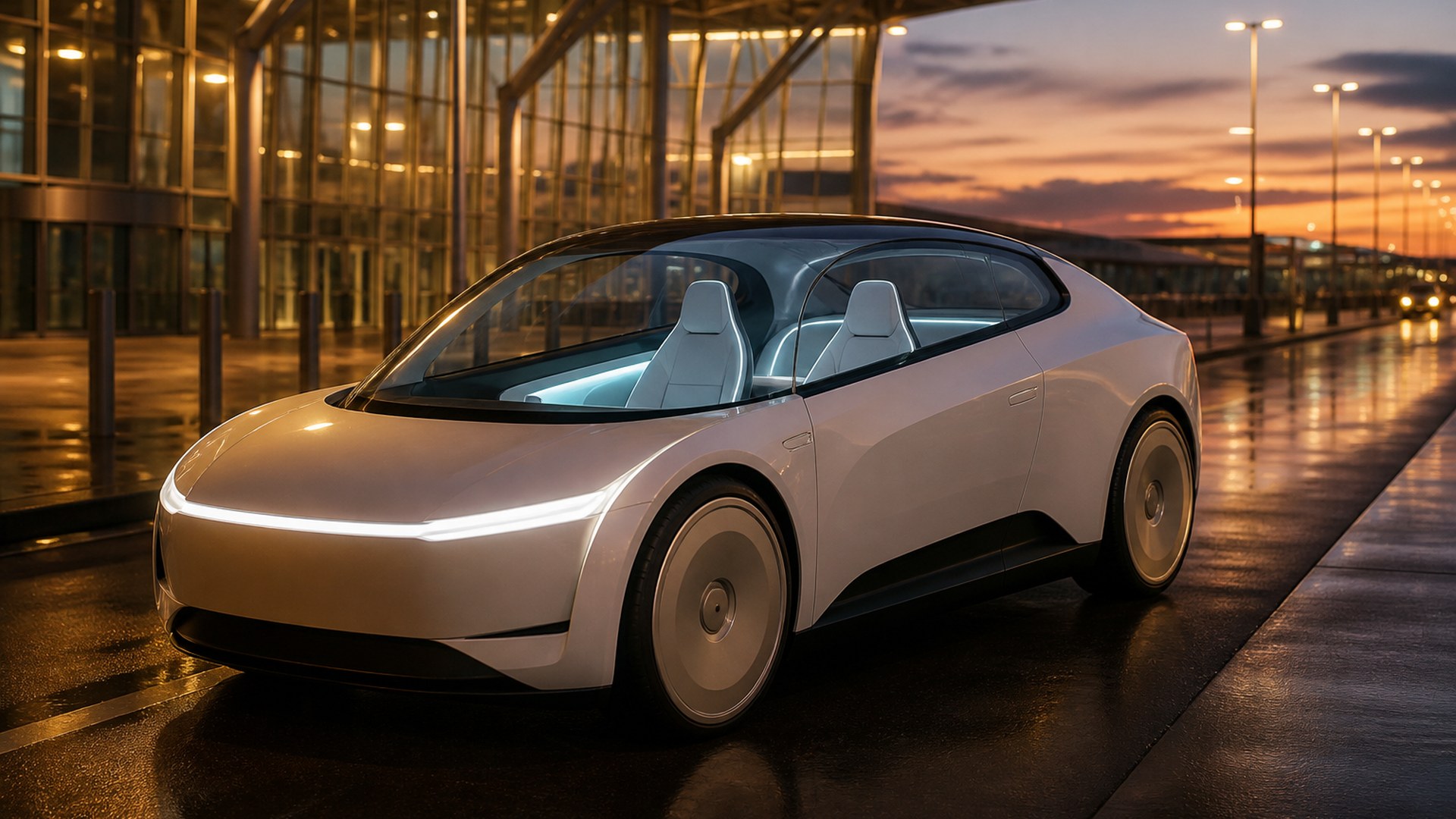
Population is listed as 1,000 estimated Cybercab vehicles. That number is the agency’s estimated scope for the query, not a Texas registration count and not a confirmed build total sitting in a yard. CNBC, reporting on 4 September, put the same estimated population in the headline and separately cited Texas Department of Motor Vehicles records as of Friday morning: 420 autonomous vehicles registered in Texas, including 45 Cybercab vehicles. Those are different ledgers. One is NHTSA’s estimated investigation population. The other is what Texas had on the book that morning. Tesla did not immediately comment to CNBC. ABC’s 4 September write-up carried the same missing-controls clause from NHTSA and likewise reported no immediate Tesla comment.
Walk the fields, not the rumour
Prompted by “Public Information” is a standard ODI field. It means the agency opened the file on information already in public view — the commercial start, the design, the certification notice — rather than on a consumer complaint code or a defect petition. Investigator Syed Rahaman owns the file. Reviewer Neil Dold signed the review line. Approver Otto Matheke signed the approval line. Subject is certification, not a named crash. Manufacturer is Tesla, Inc. Product line is Cybercab vehicles. Action is Open Audit Query.
If you’ve been following other NHTSA dockets, you already know the alphabet. PE is a Preliminary Evaluation. EA is an Engineering Analysis. RQ is a Recall Query. AQ is an Audit Query. The resume’s Action field here is AQ, and the Problem Description is process-and-data examination. That matters, because a lot of coverage collapses “investigation” into “recall” in the reader’s head. An Audit Query is not a recall. It is not a Preliminary Evaluation into a suspected safety-related defect in the field. It is NHTSA asking for the paperwork and technical basis behind a manufacturer’s certification — and, in this case, behind applicability determinations that may have taken whole families of FMVSS off the table for a vehicle with no steering wheel and no pedals.
The resume’s PDF path is public: https://static.nhtsa.gov/odi/inv/2026/INOA-AQ26002-17078.pdf. One page. Open. That is the primary. Everything else here is corroboration or public-law context around that page.
What an Audit Query is — and is not
In the United States, manufacturers generally self-certify that a new motor vehicle complies with all applicable FMVSS before it is introduced into commerce. NHTSA does not pre-approve every model the way a type-approval system in some other markets does. The agency sets the standards, manufacturers certify, and NHTSA can later investigate the basis for that certification, demand documents, inspect vehicles, and — if it finds noncompliance or a defect — pursue remedies that can include recalls, civil penalties, or other enforcement. An Audit Query sits in that after-the-fact oversight layer. It is a formal opening of a file to examine process and technical data. It is not, by itself, a finding that the car is illegal. It is not, by itself, an order to stop commercial rides. It is not a Preliminary Evaluation into a crash trend. Treat those categories as separate until the agency merges or closes them.
The Verge’s Andrew J. Hawkins, writing on 4 September, put the self-certification structure in plain language: automakers self-certify compliance with applicable FMVSS; if problems appear — including vehicles introduced without features that many standards assume — NHTSA can investigate that self-certification process. That investigation “doesn’t block the automaker from continuing its production,” Hawkins wrote, while still putting the vehicle’s regulatory footing under review. The AQ resume lines up with that description. Tesla has notified the agency of certification and of expansion plans. NHTSA has opened the audit. Commercial deployment, as of the resume’s own summary, had already begun with a small number of vehicles in Austin on the open date.
Don’t confuse AQ26002 with the separate Full Self-Driving probe that secondary coverage has mentioned in passing — a much larger population, on the order of about 3.2 million vehicles, according to The Verge’s 4 September piece. Different docket, different product, different question. Mention it once so the files stay apart, then leave it. This morning’s story is Cybercab certification.
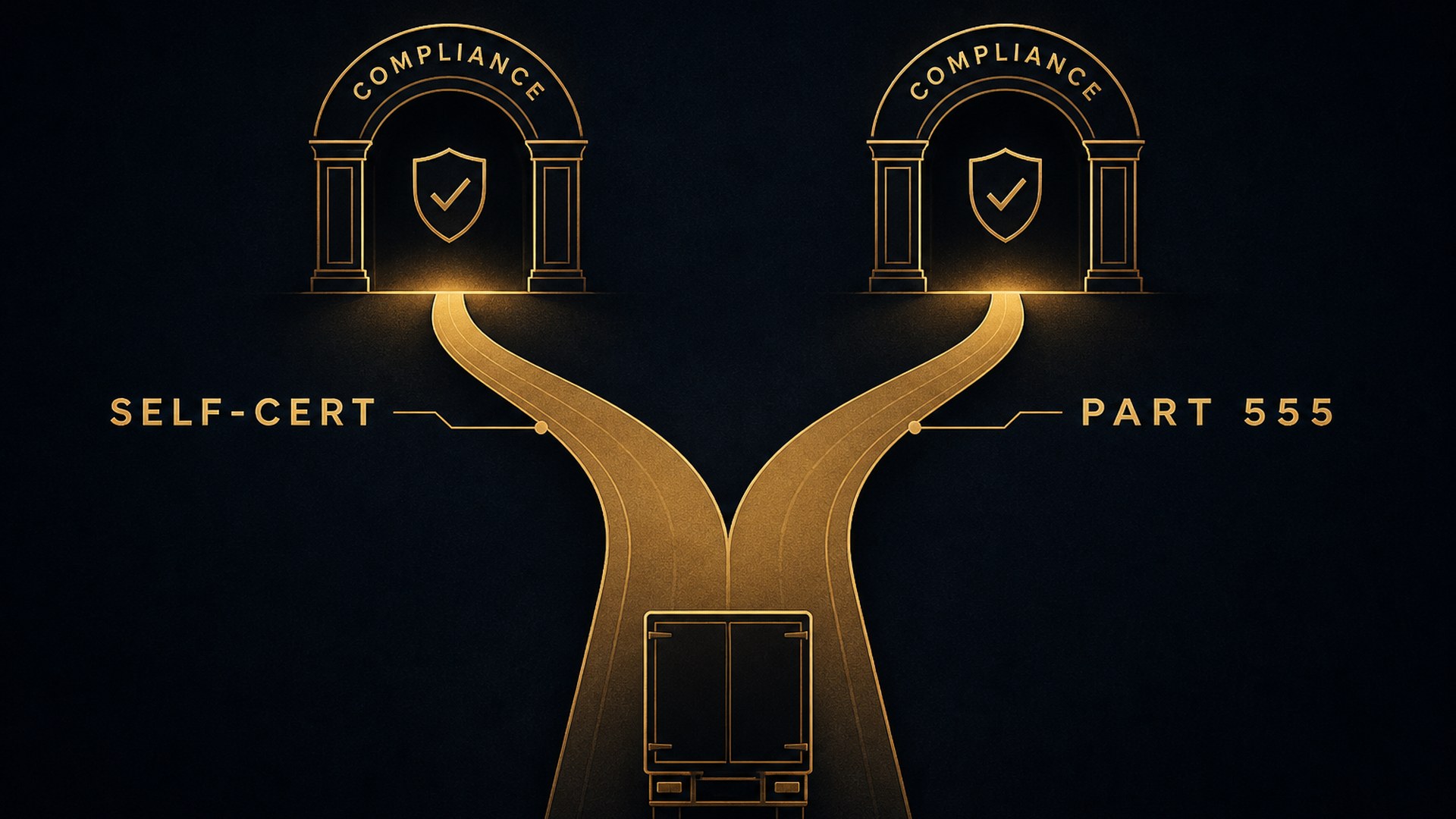
Self-certification versus the Part 555 exemption pathway
Here’s the regulatory fork that actually drives this file. Many FMVSS were written around a human driver. They assume someone sits in a driver’s seat, reaches a steering wheel, presses a brake pedal, and uses mirrors. A purpose-built robotaxi without those permanently attached conventional controls runs straight into that drafting history. Manufacturers have, in public practice, faced two broad approaches.
One approach is self-certification: the manufacturer decides which standards apply to the vehicle as designed, certifies compliance with those that apply, and — where it concludes a standard does not apply because the vehicle has no human driver controls of the kind the standard addresses — treats that standard as inapplicable. That determination is the manufacturer’s, made under the self-certification system. NHTSA can later examine whether those determinations hold.
The other approach is to petition NHTSA for a temporary exemption under the Part 555 framework (and related exemption authorities the agency has used for automated driving system vehicles). In that path, the manufacturer comes to the agency before or instead of asserting full applicable-FMVSS certification, asks for relief from specific standards, and — if granted — operates under the terms, caps, and conditions of the exemption. The Verge reported on 4 September that Tesla does not appear to have sought an FMVSS exemption for the Cybercab, which is why the self-certification audit is the live question.
NHTSA Administrator Jonathan Morrison, in a statement carried by The Verge and other outlets on 4 September, said: “NHTSA fully supports the safe development and deployment of automated vehicles. But as the federal regulator, we need to ensure that all of our laws are followed. Our approach of balancing innovation with safety oversight will allow the United States to maintain its global leadership in AV innovation.” That is the agency’s public posture in one breath — support for deployment, insistence on the law, and a claim that the balance preserves U.S. leadership. It does not pre-judge AQ26002. It does tell you how the administrator wants the inquiry framed.
Part 555, as used in recent automated-vehicle practice, is the formal temporary-exemption route for vehicles that do not meet certain FMVSS. Grants can come with vehicle caps, reporting conditions, and ongoing oversight. They are public processes with dockets. Self-certification, by contrast, puts the manufacturer’s applicability and compliance determinations first and the agency’s examination second. Tesla’s Cybercab, on the public record available here, is in the second posture: certified as compliant with all applicable FMVSS, with NHTSA now asking how much of that certification depends on “inapplicable” calls. The resume’s last sentence is that question in official prose.
If Tesla’s technical package treats standards written for steering columns, service-brake pedals, or exterior mirrors as inapplicable because the Cybercab has none of those permanently attached conventional controls, then AQ26002 is where NHTSA examines that package. If the agency later disagrees, the remedies live in the enforcement toolbox — not in this opening resume. The opening resume only opens the file.
The missing-controls list, line by line
The resume is specific. “The vehicles lack permanently attached, conventional manual controls, such as a brake pedal, gas pedal, steering wheel, and mirrors.” Four examples, one clause. Brake pedal. Gas pedal. Steering wheel. Mirrors. “Permanently attached” and “conventional” are doing work in that sentence. The design is not a Model Y with Autopilot and a wheel still bolted in. It is a Cybercab without those conventional driver controls as permanent equipment.
ABC’s 4 September story quoted the same clause and tied it to the investigation’s focus: process and technical data for certification, including whether Tesla was correct in determining that certain federal standards were not applicable. CNBC’s 4 September story listed steering wheel, brake pedal, accelerator pedal, and mirrors in the same breath. The Verge framed the absence of sideview mirrors, pedals, and steering wheel as features “required under” FMVSS in the traditional reading — and then immediately quoted NHTSA’s own inapplicability language, which is the live legal hinge. Required if applicable. Inapplicable if the manufacturer’s determination holds and the agency does not overturn it. That is why the AQ exists.
The resume does not describe passengers, lighting, or how a ride felt. It lists controls that are not there, and it opens an audit into the certification that followed from that design.
One thousand estimated, forty-five on the Texas book
Hold two numbers without forcing them to be the same thing. NHTSA’s population field: 1,000 (Estimated) Tesla Cybercab vehicles. CNBC’s Texas DMV figure as of Friday morning, 4 September: 420 autonomous vehicles registered in Texas, of which 45 are Cybercab. The Verge independently reported 45 Cybercabs registered with the Texas DMV and noted uncertainty about whether a thousand even exist yet. Estimated investigation population is a scope number for the query. State registration is a count of what Texas had recorded that morning. A small commercial deployment in Austin on 3 September is consistent with a low two-digit Cybercab registration figure even while the AQ covers an estimated thousand. Don’t collapse those into a single “fleet size” without saying which ledger you mean.
Tesla’s expansion notice, per the resume, is gradual — additional vehicles and locations. That is a plan notification to the agency, not a schedule with dates in the resume. Watch for later filings if the population estimate moves, if Texas registrations climb, or if NHTSA issues information requests that surface in the public docket.
The Zoox parallel, without turning it into prophecy
Amazon-owned Zoox is the closest public parallel for a purpose-built, steering-wheel-free vehicle that tried self-certification and then faced NHTSA process. Secondary reporting maps a multi-year arc. Zoox publicly self-certified; NHTSA opened scrutiny of that certification; an Audit Query into Zoox’s process and technical data followed; during the investigation Zoox’s purpose-built vehicles operated under tighter constraints — demonstration rather than unrestricted commercial fare collection, as The Verge summarised on 4 September. Zoox later pursued exemption relief. ABC’s 4 September Cybercab story said that last year NHTSA closed its Zoox investigation and granted Zoox permission to commercially deploy through its first temporary exemption for American-built autonomous vehicles. The Verge’s 4 September Cybercab piece said Zoox could not charge passenger fares until NHTSA granted permission “just this past July” — two years after the self-certification fight began in public view. TechCrunch and Federal Register materials around Zoox’s later commercial temporary exemption describe a Part 555-style grant with vehicle caps and enhanced oversight; those are Zoox’s pathway facts, not Tesla’s.
Two timelines, not one fate. Zoox: self-cert claim, agency audit, demonstration limits, then exemption and, later, commercial clearance under exemption terms. Tesla Cybercab: commercial deployment notification and FMVSS certification notification on 3 September 2026, AQ26002 opened the same day, no public Part 555 petition appearing in the secondary reporting cited here. The parallel tells you why NHTSA knows how to run this kind of file. It does not tell you that AQ26002 must end the same way. The resume does not forecast a forced exemption, a stop-sale, or a clean close. Neither does this piece.
What the Zoox file does clarify, for readers new to this alphabet, is the difference between “on the road under demonstration rules” and “commercially deploying under a claimed full applicable-FMVSS certification,” and the difference between both of those and “operating under a granted temporary exemption with caps and conditions.” Tesla’s resume language is commercial deployment plus certified compliant with all applicable FMVSS. Zoox’s resolved path, per ABC and Verge, ran through investigation, demonstration limits, and exemption. Different boxes on the same regulatory shelf.
Expansion plans are already in the resume
Expansion is not a rumour. The resume states that Tesla notified the Agency it plans to gradually expand commercial deployment of the Cybercab to include additional vehicles and locations. That sentence sits next to the Austin start date and the certification notice. NHTSA opened the AQ knowing that notification was on the table. Gradual expansion is therefore part of the factual backdrop for the audit, not a separate scoop. What “gradually” means in vehicle counts and city lists is not spelled out on the one-page resume. Watch subsequent manufacturer submissions and agency correspondence if they become public.
What to watch next
First: the process exam. AQ26002’s problem description is examination of process and technical data. Expect information requests, document production, and — if the Zoox precedent is any guide — possible vehicle inspection. None of that is promised on the face of the opening resume; it is how audit queries of this type have worked when the agency digs into certification basis.
Second: applicability determinations. The resume’s closing focus — “the extent to which Tesla’s certification depended on determinations that certain FMVSS are inapplicable to the Cybercab” — is the legal centre. If Tesla’s package treats mirror, steering, or brake-control standards as inapplicable, NHTSA will have to decide whether those determinations stand. That decision is not in the opening document.
Third: pathway choice under pressure. Secondary reporting emphasises that Tesla does not appear to have sought an FMVSS exemption. If the audit pushes the company toward a Part 555 petition, that would be a visible shift from the current self-cert posture. If the agency accepts the applicability determinations, the AQ can close without that shift. Both outcomes are possible on the public facts; neither is written on page one of AQ26002.
Fourth: population versus registration. Keep the 1,000 estimated and the 45 Texas-registered Cybercabs in separate columns. Updates to either number will matter for scale, not for the legal theory of the audit.
Fifth: separate dockets. Don’t merge this file with the large FSD probe (~3.2 million vehicles in The Verge’s aside) or with ordinary crash-based PEs. Certification audit is its own question.
Sixth: manufacturer comment. As of the 4 September CNBC and ABC reports cited here, Tesla had no immediate comment. Silence is not a finding. It is a status.
How FMVSS self-certification actually works in practice
If you only cover cars with steering wheels, self-certification can sound abstract. It isn’t. When a manufacturer introduces a conventional passenger car into U.S. commerce, it issues a certification that the vehicle complies with every applicable FMVSS. Those standards cover crashworthiness, lighting, brakes, controls and displays, rear visibility, glazing, and dozens of other topics. The manufacturer’s certification is a legal representation. NHTSA can test vehicles, review records, and open investigations if something looks off. Most of the time, for a vehicle that still has a driver’s seat and conventional controls, the applicability question is narrow. The standards were written for that vehicle class.
A Cybercab-type design flips the applicability question from narrow to central. Standards that tell you how a steering column must behave, how a service-brake pedal must be arranged, or how outside mirrors must provide a field of view assume hardware that this vehicle does not permanently attach. The manufacturer then has to decide, standard by standard, whether a given FMVSS applies to the vehicle as designed. If the answer is yes, the vehicle must meet it. If the answer is no — because the standard’s text or purpose is tied to equipment the vehicle does not have — the manufacturer treats that standard as inapplicable and certifies compliance with the remaining applicable set. AQ26002 exists to examine the process and technical data behind those calls for the Cybercab, and “among other things” the extent to which certification depended on inapplicability determinations.
That is why the resume’s problem description does not read like a crash trend analysis. It reads like a certification audit. Process. Technical data. Related issues. Inapplicability. Those are lawyer-and-engineer words, and they are the right ones for this file.
Self-certification also explains the same-day timing without conspiracy language. Tesla notified the Agency of certification and of commercial deployment. The vehicles are the kind that make applicability contested on their face — no permanently attached conventional brake pedal, gas pedal, steering wheel, or mirrors. NHTSA’s Office of Defects Investigation / OVSC resume machinery can open an Audit Query on public information the same day rides begin. Prompted by Public Information. Date opened 09/03/2026. That is the sequence the primary document records.
Part 555 and what an exemption buys you
The Part 555 temporary-exemption pathway is the formal alternative when a manufacturer needs to put vehicles into commerce that do not meet one or more FMVSS. In broad public terms, a petitioner asks NHTSA for temporary relief from specified standards, makes a safety and hardship or equivalent-safety case under the applicable exemption bases, and, if granted, receives a time-limited, often volume-capped permission to manufacture and sell or otherwise deploy noncompliant vehicles under stated conditions. Recent automated-vehicle practice has also used related demonstration and commercial exemption tools; Zoox’s path, as summarised by ABC and The Verge, ran from self-cert scrutiny into demonstration permission and then into a temporary commercial exemption.
What an exemption buys you, in practical terms, is a public agency decision that names the standards you need not meet, the number of vehicles you may build or deploy under the grant, the reporting you owe, and the oversight the agency keeps. What self-certification buys you, if it holds, is the ability to proceed without that public petition — because you have determined the vehicle already complies with all standards that apply to it. The risk of self-certification, when the design sits outside the historical FMVSS driver-control assumptions, is exactly the risk AQ26002 embodies: the agency opens an audit into your process and technical data after the fact.
The Verge’s 4 September reporting is direct on Tesla’s posture: Tesla does not appear to have sought an FMVSS exemption, thus prompting the investigation framing around self-certification. CNBC and ABC do not claim a Tesla Part 555 petition either. The resume itself never mentions Part 555; it mentions certification, applicable FMVSS, and inapplicability determinations. Read together, the public record is: Tesla certified; NHTSA opened an AQ into that certification; no exemption petition is in the cited secondary coverage.
Morrison’s quote sits on top of that fork. Support for safe AV development and deployment. Insistence that laws be followed. A claim that balancing innovation with safety oversight keeps U.S. leadership. For a reader, that statement is not a verdict on AQ26002. It is the administrator saying the agency will run the oversight process even while it says it wants deployment.
Audit Query versus Preliminary Evaluation versus recall
Reporters and readers mash these together. Keep them apart.
A recall, in NHTSA’s world, is a manufacturer’s (or ordered) campaign to remedy a safety-related defect or a noncompliance. It has owner notification, remedy obligations, and a public campaign identity. AQ26002’s Action field is not “Recall.” It is “Open Audit Query (AQ).”
A Preliminary Evaluation (PE) is typically the first formal stage when ODI is looking at a potential safety-related defect pattern — often complaint- or crash-driven — and deciding whether to upgrade to an Engineering Analysis. AQ26002’s problem description is not a PE defect theory. It is examination of certification process and technical data.
An Audit Query, in the sense used on this resume and in the earlier Zoox certification file, is an examination of how and on what technical basis a manufacturer certified. It can lead to findings about noncompliance, to inspection reports, to dialogue that pushes a company onto an exemption path, or to closure if the agency is satisfied. The opening resume does not pick that ending. It opens the file.
Related issues, in the resume’s phrase “certifying the Cybercab and related issues,” leaves room for adjacent questions the investigator may pull in — document completeness, how applicability was documented, how Tesla described the vehicle to the agency — without turning the AQ into a crash PE on day one. Stay precise: related issues are still inside a certification audit until the agency says otherwise.
Zoox timeline in dated steps
Spell the parallel as a sequence of public steps, not as mood.
Zoox self-certified its purpose-built, steering-wheel-free vehicle and put that claim in public view around 2022–2024 coverage of its certification posture. NHTSA scrutinised the basis for that certification, including through special-order and audit-query mechanisms described in agency resumes and secondary reporting. An Audit Query examined process and technical data — language that mirrors AQ26002’s problem description almost beat for beat. During the investigation, per The Verge’s 4 September Cybercab story, Zoox could operate for demonstration purposes but could not charge passenger fares until permission arrived. ABC’s 4 September Cybercab story said that last year NHTSA closed its Zoox investigation and granted Zoox permission to commercially deploy through its first temporary exemption for American-built autonomous vehicles. The Verge dated the fare-charging permission to July (in the 4 September 2026 article’s “just this past July” phrasing). Later Federal Register and trade coverage describe a commercial temporary exemption with annual vehicle caps and enhanced oversight conditions.
Map that against Tesla on 3–4 September 2026. Tesla begins small commercial deployment in Austin and notifies certification to all applicable FMVSS. NHTSA opens AQ26002 the same day. Secondary coverage finds no Tesla FMVSS exemption petition. Texas DMV shows 45 Cybercabs among 420 autonomous registrations Friday morning. Estimated AQ population: 1,000. Tesla: no immediate comment in CNBC and ABC reports.
The parallel is structural: same agency, same kind of vehicle-control absence, same self-certification tension, same audit-query tool. The timelines are not locked together. Zoox’s multi-year path through demo limits and exemption is what happened to Zoox. Tesla’s path will be whatever AQ26002 and subsequent filings produce.
Why “applicable” is the whole fight
Ordinary English treats “safety standards” as a single pile. The legal system does not. Certification is to applicable FMVSS. If a standard is not applicable, you do not certify compliance with it; you exclude it from the applicable set. The Cybercab’s missing permanently attached conventional controls make that exclusion argument available for standards that presuppose those controls. NHTSA’s resume says the agency will consider how far Tesla’s certification depended on those exclusions. That is the fight in one sentence.
Applicability is not the same as a waiver. A waiver or exemption is agency permission to not meet a standard that would otherwise apply. An inapplicability determination is a claim that the standard never attached to this vehicle in the first place. AQ26002 is built to test the second kind of claim against process and technical data. If the agency later concludes some standards did apply, you have a noncompliance theory. If the agency agrees they did not apply, the self-certification posture holds on that point. The opening resume does not announce either conclusion.
Numbers that hold up
- Investigation ID: AQ26002
- Opened: 3 September 2026 (resume: 09/03/2026)
- Prompted by: Public Information
- Investigator / Reviewer / Approver: Syed Rahaman / Neil Dold / Otto Matheke
- Subject: Tesla Cybercab FMVSS Certification
- Manufacturer / products: Tesla, Inc. / Tesla Cybercab vehicles
- Population: 1,000 (Estimated)
- Action: Open Audit Query (AQ)
- Austin commercial start: 3 September 2026, small number of vehicles (resume)
- Missing controls listed: brake pedal, gas pedal, steering wheel, mirrors (permanently attached, conventional)
- Texas DMV as of Friday morning 4 September (CNBC): 420 autonomous vehicles registered in Texas, including 45 Cybercab
- Tesla comment to CNBC/ABC as of those stories: none immediate
- Morrison statement (Verge 4 Sep): supports safe AV development and deployment; laws must be followed; balance innovation with safety oversight for U.S. leadership
- Separate FSD probe population mentioned in Verge: about 3.2 million vehicles (different docket; mention only to keep files separate)
- Primary PDF: https://static.nhtsa.gov/odi/inv/2026/INOA-AQ26002-17078.pdf
Those are the load-bearing facts. The rest of this piece is explanation of what those facts mean in the FMVSS system.
Reading the resume against expansion plans
Because Tesla notified plans to expand gradually to additional vehicles and locations, the audit’s estimated population of 1,000 is not a curiosity — it is a forward-looking scope number sitting next to an expansion notice. A small Austin start can coexist with a four-digit estimate if the agency is sizing the query for the certified design as deployment grows. Conversely, if builds and registrations stay near the 45 Texas Cybercab figure for months, the estimate will look conservative or premature depending on what Tesla actually fields. The resume does not resolve that. It just puts both the small start and the expansion notice in the same summary paragraph as the AQ opening.
For readers outside the U.S., one more note: this is a federal motor-vehicle standards fight under NHTSA’s self-certification system, not a European-style type-approval gate that clears the design before the first commercial kilometre. The first commercial kilometres in Austin and the first AQ page landed on the same calendar day. That coincidence is the hook. The substance is the certification basis.
Close
Same day, two public facts: commercial Cybercab rides in Austin, and OVSC resume AQ26002 opened to examine Tesla’s FMVSS certification process and technical data. Investigator Syed Rahaman. Reviewer Neil Dold. Approver Otto Matheke. Prompted by public information. Population estimated at 1,000. Vehicles without permanently attached conventional brake pedal, gas pedal, steering wheel, and mirrors. Action: Open Audit Query — not a recall, not a Preliminary Evaluation into a field defect, an audit of certification and of inapplicability determinations. Self-certification put Tesla on the road under its own applicable-FMVSS call; Part 555 remains the formal exemption path Tesla does not appear, on the cited reporting, to have taken. Zoox’s multi-year arc from self-cert scrutiny to demonstration limits to temporary exemption is the nearest parallel, not a script. Morrison’s statement balances support for AV deployment with “all of our laws are followed.” Texas had 45 Cybercabs on the book Friday morning inside 420 autonomous registrations; NHTSA’s estimate for the query is a thousand. Expansion plans are already in the resume. The next chapter is whatever the process exam and the applicability review produce — on paper, with dates, when the agency or the manufacturer puts them in public view.
Primary source: NHTSA OVSC resume, Investigation AQ26002, https://static.nhtsa.gov/odi/inv/2026/INOA-AQ26002-17078.pdf. Corroboration: CNBC 4 September 2026; The Verge (Andrew J. Hawkins) 4 September 2026; ABC News 4 September 2026.
The paper
Comments
No notes on this story yet.
Sign in to comment