
Isar Aerospace’s Spectrum rocket lifted from Andøya Spaceport in Arctic Norway on 5 September 2026 at 20:12 UTC on the mission named Onward and Upward, the company’s second flight.
Company and European Commission statements the same day said the vehicle reached orbit and deployed customer payloads, marking the first time a privately developed rocket had reached orbit from continental Europe.
If you’ve been watching Europe’s launch gap for years, you already know why this one lands differently. Kourou in French Guiana has carried European institutional traffic for decades. Western Europe’s own coastline hadn’t put a commercial orbital rocket into space until Spectrum cleared the bar on flight two — seventeen months after a debut that ended less than a minute after liftoff when the vehicle lost control and came down short of orbit.
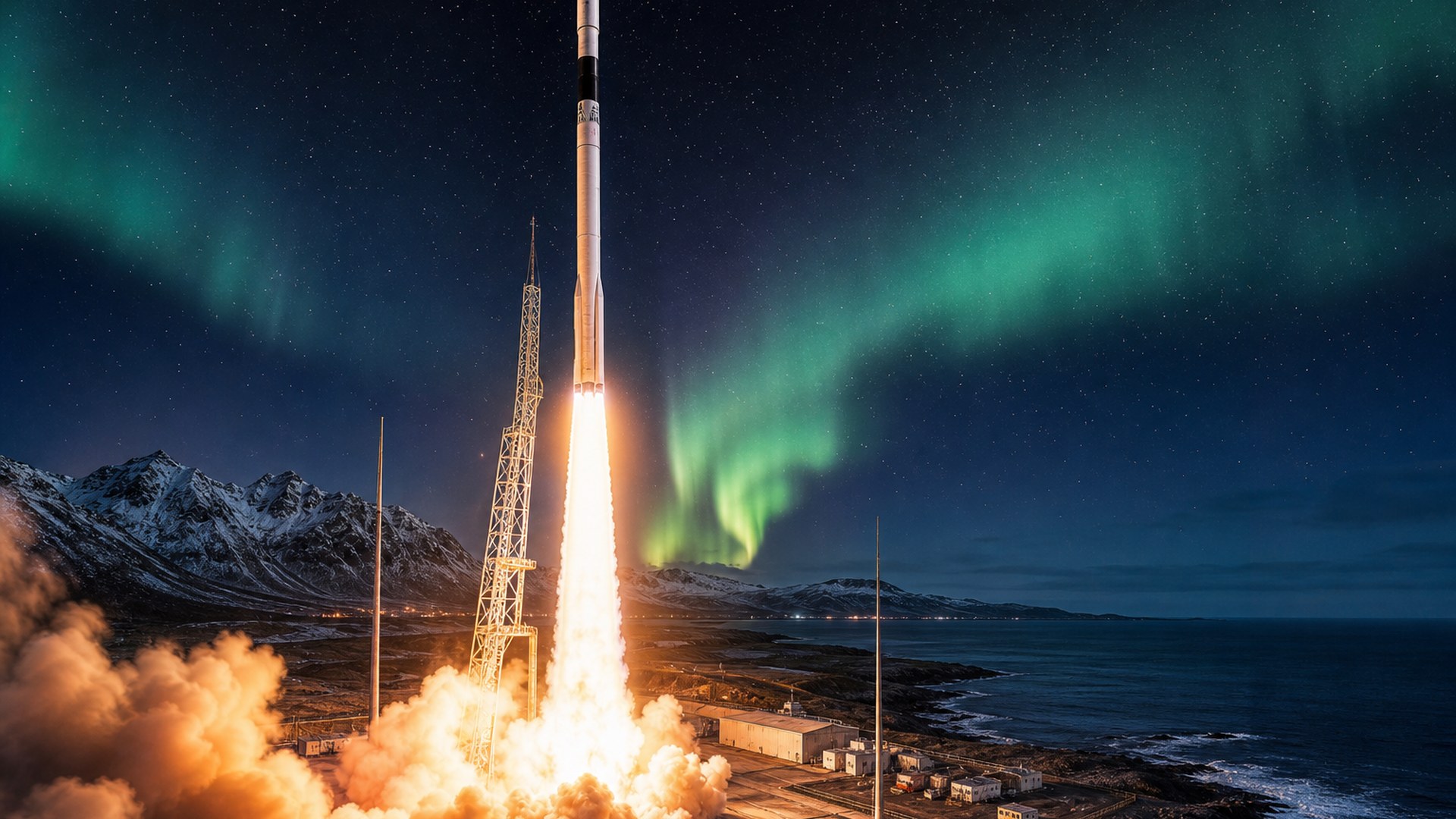
Andøya sits well inside the Arctic Circle on Norway’s coast, roughly 300 kilometres north of the Arctic Circle line depending on how you draw it. That geography isn’t a tourist footnote. High-inclination and sun-synchronous orbits are the bread and butter of Earth-observation and climate satellites, and a polar launch corridor over open water is exactly what those missions want. Isar built a dedicated complex there. The flight path from that pad is the product, not an afterthought.
Spectrum itself is a two-stage vehicle about 28 metres tall with a roughly 2-metre diameter. Public mission materials listed a low-Earth-orbit payload class around 1,000 kilograms and liftoff thrust on the order of 675 kilonewtons. For a European startup, that’s the working scale for rideshare and smallsat customers who don’t need a heavy lifter — and who’ve been waiting for a local alternative to booking seats on someone else’s schedule halfway around the world.
Onward and Upward carried five CubeSats plus a non-separable technology experiment under ESA’s Boost! programme: CyBEEsat from TU Berlin, TriSat-S from the University of Maribor, Platform 6 from EnduroSat, FramSat-1 from NTNU, SpaceTeamSat1 from TU Wien Space Team, and the Let It Go experiment from Dcubed. Isar said it was working with customers to confirm satellite status after separation. That’s the honest post-flight cadence — orbit is necessary, but operators still check health once the radios wake up.
Why care about a second flight from a German company on a Norwegian island? Launch capacity has been the bottleneck everyone names and few solve. Europe’s institutional fleet and Arianespace heritage matter. So does having a commercial line that can iterate on a few-year clock instead of a decade-long programme review. Flight one failed early. Flight two completed the orbital sequence, including a circularisation burn and spacecraft separation according to Isar’s update. That’s how you turn a prototype programme into a service you can sell.
The timing also fits a wider European launch-startup fundraising conversation that was already in the air the same week Ars Technica’s Rocket Report had listed Spectrum among the next three launches to watch — then targeting around 4 September near 20:00 UTC. Windows move. Next Spaceflight and other trackers had shown a window open near that hour. The point of that preview was the attempt itself. The point of the 5 September outcome — liftoff at 20:12 UTC, or 22:12 CEST local — is that the attempt closed the loop on a second try.
Isar’s CEO and co-founder Daniel Metzler put it without ceremony in the company release: launch remains the largest bottleneck for the global space industry, and from that day the company argued there was a true alternative for commercial and institutional customers. Weigh the marketing language yourself. The hardware fact is simpler. A Spectrum left Andøya and, on Isar’s and the European Commission’s reporting, put payloads on orbit. The Commission’s Directorate-General for Defence Industry and Space called it a key step for Europe’s autonomous access to space and noted the flight as a combined flight and qualification campaign under real operational conditions.
There’s an industrial subplot worth keeping on your radar. Isar has said Spectrum vehicles 3 through 7 are already in production, and it’s building toward a large integrated production facility — public figures have cited roughly 40,000 square metres and a long-term rate of up to 40 vehicles a year once that plant is fully open. Ambition isn’t inventory. Treat the annual rate as a design goal until the line proves it. What you can report now is that the company isn’t waiting for a third flight to start stacking the next cores, and that vertical integration and automation are part of how it says it will scale.
Geography expands too. Beyond Andøya, Isar has been building toward a launch complex in Nova Scotia, Canada, aimed at mid- to high-inclination orbits that Earth-observation and communications customers need. A European manufacturer with Atlantic options on both sides of the ocean is a different competitive map than a single polar pad. Range licensing, weather, and local politics will decide how fast that second site matters. The stated plan is already on the record.
For Norway, Andøya Spaceport’s role as a European polar site just got a concrete proof point. For ESA’s Boost! customers, five CubeSats and an experiment rode a commercial European stack instead of hitchhiking on someone else’s schedule. For the rest of us reading launch manifests, the list of places that can put mass on orbit from Western European soil got its first commercial checkmark. Aviation Week and other trade outlets framed it the same way: a regional first for a launcher startup reaching orbit from a European spaceport.
This isn’t the end of Europe’s launch dependence overnight. One successful second flight doesn’t fill a manifest for a decade. It does change the conversation from “can a European startup clear orbit from home soil?” to “how fast can they repeat it, and at what price?” That’s the question operators actually ask when they’re picking a ride for the next Earth-observation constellation or university CubeSat.
The next Spectrum will tell you more than any fundraising slide. So will Andøya’s winter weather, darkness, and range availability. Nova Scotia either comes online on something like the public timeline or it doesn’t. CubeSat operators either publish healthy beacons or they don’t — because orbit is the headline, and working satellites are the receipt. European institutional buyers will answer in their own way when a commercial alternative from continental Europe is no longer theoretical.
Fundraising chatter around European launch startups that same week sits in the background, not as a substitute for flight data. Capital follows demonstrated orbits more reliably than slides. Onward and Upward gave Isar a data point money can’t fake: a second flight that, on the company’s and the EU’s account, finished the job the first one couldn’t.
Spectrum flew from Andøya on Onward and Upward. Isar and European officials say it reached orbit and deployed payloads on only the company’s second attempt. Europe has a commercial polar launch success to point at. That’s where the story sits today.
The paper
Comments
No notes on this story yet.
Sign in to comment