
Tesla started Megapack 3 production on 6 August 2026 at its new Megafactory in Brookshire, Texas, outside Houston, the company confirmed the same day on its Megapack social channel.
The plant is designed for 50 GWh per year dedicated to Megapack 3, and it went from groundbreaking to production in 16 months — fast for a factory of that scale.
If you follow grid batteries, you already know why a third Megafactory matters. Tesla’s Lathrop, California, plant and its Shanghai Megapack lines have been running hard; Energy-Storage.News and related coverage put their combined annual output around 40 GWh. Brookshire’s designed 50 GWh for Megapack 3 alone is meant to outproduce that pair when it ramps. Designed capacity isn’t today’s run rate — say that out loud — but the floor is open and units are coming off the line.
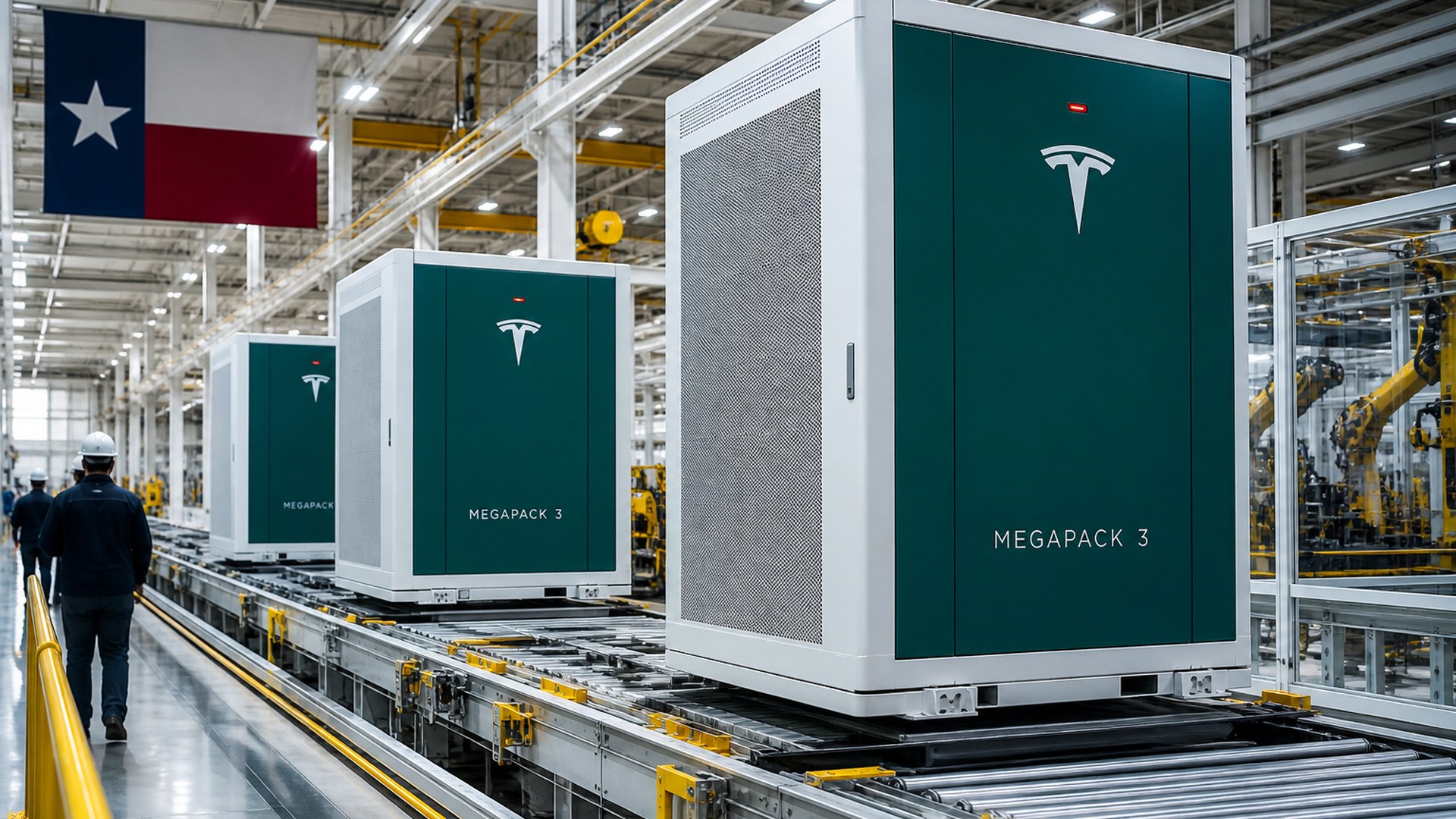
What’s different about Megapack 3? Each unit stores about 5 MWh of energy with roughly 2.5 MW of power, packing about 28 percent more energy into the same footprint as the prior generation. Electrek’s 6 August report put the step-up against the Megapack 2 XL’s roughly 3.9 MWh class in plain numbers: more storage on the same pad of dirt. For a utility planning a substation yard, footprint is money. Twenty-eight percent more energy without growing the box is the kind of spec-sheet line that shortens land fights and interconnection paperwork arguments.
Megablock is the site-level packaging story. Tesla’s denser acre approach is pitched to deploy 1 GWh faster, with coverage citing roughly a 23 percent faster install claim. Four Megapack 3 units can integrate with transformer and switchgear into a larger block architecture — public materials have described a 20 MWh Megablock class built from four of the 5 MWh cabinets. Faster install isn’t magic. It’s fewer field connection points, more factory integration, and less time for crews walking cable trays in the weather.
Customer deliveries are expected late in 2026. Production started ahead of first customer shipment, which is the normal industrial sequence: prove the line, then fill trucks. Energy-Storage.News coverage around 4 September walked through the product as Texas production began and reiterated that deliveries were aimed toward the end of the year. If you’re a buyer, that means the pitch is turning into serial hardware, but your commercial online date still sits in the late-2026 window unless your contract says otherwise.
Brookshire’s location isn’t accidental. Sitting in Waller County near Houston — Empire West industrial park territory in regional reporting — puts the factory inside ERCOT’s footprint, one of the hungriest battery-storage markets in North America. Building where the grid already wants storage shortens the distance between the factory gate and the first substations that will soak up early output. Regional outlets have described a roughly US$200 million class investment spanning site upgrades and manufacturing equipment; treat precise dollar splits as secondary to the capacity number Tesla put on the record: 50 GWh per year designed for Megapack 3.
Cell and thermal details help explain the density jump. Coverage of the Megapack 3 launch described a move to larger-format LFP cells in the 2.8-litre class and a sharp cut in thermal-system connection points — figures around a 78 percent reduction have circulated in secondary reports. Fewer joints can mean fewer leak paths and faster assembly. Enclosures in the public materials sit around 8.5 metres long and remain globally shippable. You don’t need the full bill of materials to see the manufacturing intent: simplify the plumbing, grow the cell, keep the cabinet movable.
How does this sit against the competition? CATL, Fluence, BYD and others are chasing the same utility tenders. Tesla’s answer is more factory, denser product, and a Megablock install story aimed at cutting time-to-energize. Groundbreaking to production in 16 months is a real construction tempo, and starting the line in August with deliveries still scheduled for late 2026 shows Tesla is sequencing manufacturing ahead of revenue recognition the way a factory company should.
Designed 50 GWh is not the same as shipping 50 GWh in year one. Ramps take months. First articles teach the line. Utilities still have interconnection queues that can dwarf any factory’s enthusiasm. The news on 6 August — and the September product explainers that followed — is that the Texas line exists, Megapack 3 is rolling, and the capacity target is on the wall. Tesla Megapack’s own post was blunt: Megapack 3 officially rolling off the line at the newest Megafactory in Brookshire, 16 months from groundbreaking to operation, 50 GWh/year designed capacity dedicated to Megapack 3.
For Texas grid planners, another domestic source of multi-MWh cabinets is practical insurance against import delays and shipping bottlenecks. For Tesla Energy, Brookshire is the scale bet that Lathrop and Shanghai alone couldn’t cover as demand rose. The measurable pieces are simple: production start confirmed 6 August 2026; 16 months from dirt to line; about 5 MWh and 2.5 MW per cabinet; roughly 28 percent more energy in the same footprint; Megablock install-speed claims around 23 percent faster toward a 1 GWh deployment; late-2026 customer deliveries; Lathrop and Shanghai still contributing on the order of 40 GWh combined.
Discharge-duration flexibility up to multi-hour classes shows up in product explainers too, which matters for ERCOT evening ramps and for markets that pay for longer-duration storage. Specs will vary by configuration and inverter pairing. What doesn’t vary is the factory fact: Texas is now building the denser generation while California and Shanghai keep feeding the prior volume.
A 5 MWh cabinet at roughly 2.5 MW also shapes how developers model duration. Two-hour class discharge sits naturally near those numbers; longer-duration configurations depend on how the site is built and how inverters are paired. Product explainers that mention up to multi-hour optimisation are describing a family of use cases, not a single fixed runtime for every project.
Sixteen months from groundbreaking to production will be the line rivals get asked about in every earnings Q&A. Whether Brookshire hits a meaningful fraction of 50 GWh in 2027 is the harder follow-up. August’s announcement only answers the first question: the Megapack 3 line in Texas is real, and the denser generation has started its factory life.
Install crews care about crane picks, cable counts, and how many days a pad stays fenced. A Megablock that arrives denser and claims roughly 23 percent faster deployment toward a 1 GWh site is aimed at those calendars, not at conference stages. Whether every project hits that percentage depends on soil, switchgear lead times, and utility witness testing — but the product thesis is clear: move complexity into the factory so the field goes faster.
Megapack 3 is in production in Texas. The factory is young. The product is denser. Deliveries come next. Lathrop and Shanghai haven’t gone quiet. Fifty gigawatt-hours a year is the design number on the Brookshire wall. That’s enough for now.
The paper
Comments
No notes on this story yet.
Sign in to comment