
One Nation put numbers on the table this morning. Renters and mortgage holders would be allowed to peel three percentage points off the twelve per cent super guarantee and take that slice as cash for up to three years.
Here’s what happened. The ABC’s Courtney Gould opened the federal politics live blog just before seven, Adelaide time roughly matching the eastern posts from about 6:58 a.m. AEST. After weeks of teasing, Pauline Hanson’s party formally dropped the policy on Monday, 7 September 2026. The employer still remits the full twelve per cent. The diversion, if you opt in, comes from the fund to you. Existing balances stay put. At least nine per cent keeps going to retirement.
That’s the short version. The longer fight is the one Labor has been preparing since August, a Coalition that is not buying the headline, and a One Nation treasury spokesman arguing the current hardship rules are a maze. You should hear the mechanics before the slogans.
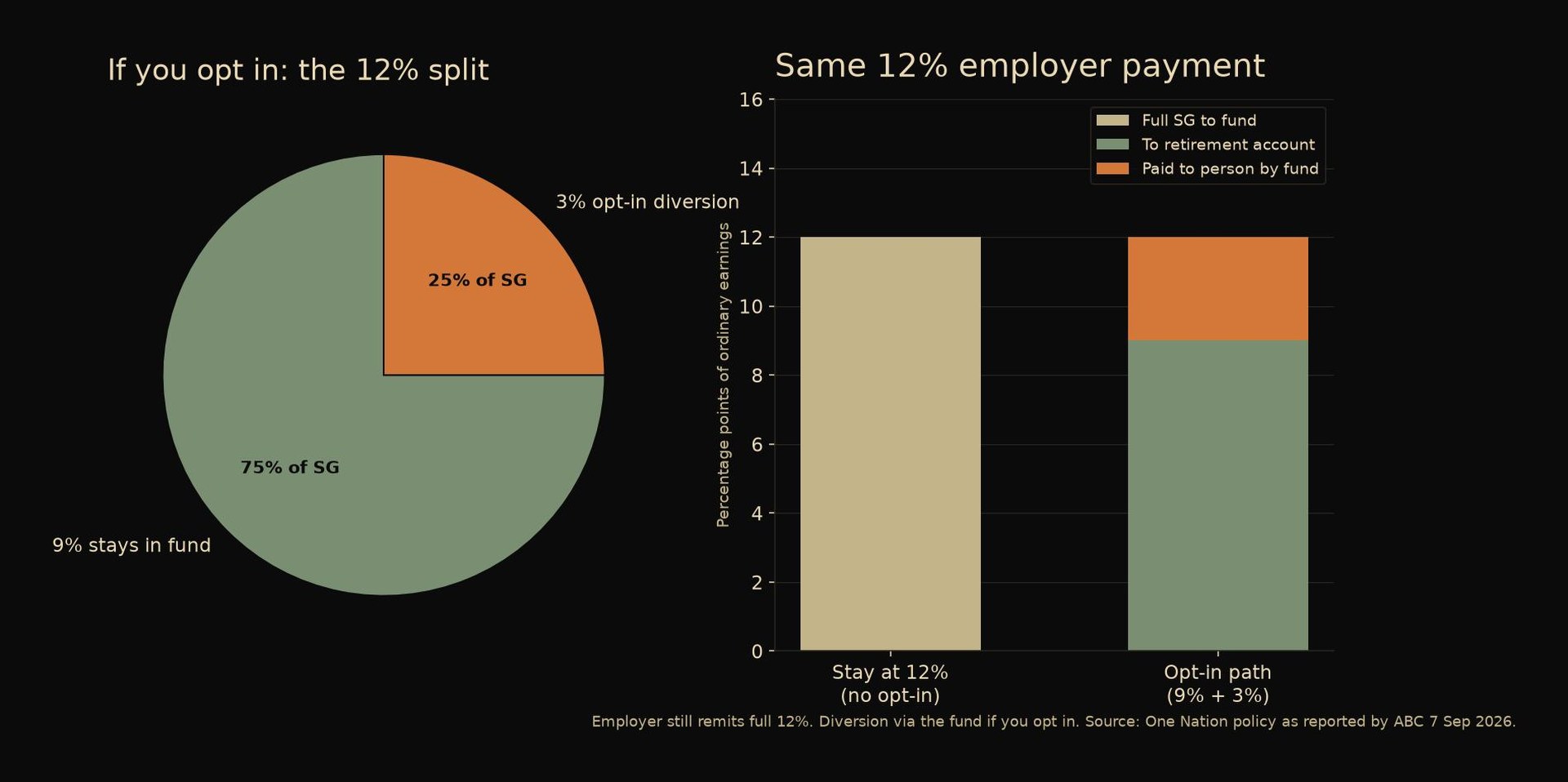
Under the proposal, Australians paying rent or holding a mortgage get a choice. They may divert three percentage points of the compulsory twelve per cent Superannuation Guarantee into take-home pay. The window is capped at three years. If you take the boost, Hanson says, at least nine per cent continues into retirement savings. The party frames it as breathing room on groceries, power bills, and the cost of raising a family.
Here’s the plumbing detail, reported the same morning: the employer still pays the full twelve per cent. The three per cent is paid to the person by the super fund. The payments still face the fifteen per cent concessional contributions tax, not the person’s marginal income tax rate. That tax point matters. It is not a straight wage rise. It is a diverted concessional contribution, taxed like a contribution, then handed across.
Hanson put it this way, verbatim from Gould’s live blog:
“That’s a real boost to help you pay the rent or the mortgage, leaving more room for groceries, power bills and the costs of raising a family. Your existing super won’t be touched. Not one dollar.”
Second beat, also verbatim:
“This only applies to future contributions. If you take the boost, at least 9 per cent will continue going towards your retirement and the choice is limited to three years.”
Read those lines again. Future contributions only. Not one dollar of the balance already sitting in the account. Three years maximum. Nine per cent floor. That is the party’s written pitch as it stood on Monday morning.
Labor did not wait for the afternoon sitting. Treasurer Jim Chalmers went to the House of Representatives doors — the spot where reporters lob questions at arriving MPs — and named the policy in existential terms.
He accused One Nation of wanting to “end superannuation as we know it.” He said it was “now beyond doubt that any Coalition government with One Nation in it will cut your super.” Less money, he argued, and less economic security for millions of workers. Every time One Nation is asked to support workers’ financial interests, he said, they oppose those interests. Ending super as we know it, making workers poorer, was “exactly why One Nation poses an unacceptable and dangerous risk to Australian workers.”
That language tracks a line Labor has been running for weeks. More on the August ads in a moment. First, the rest of Monday’s microphone round.
Social Services Minister Tanya Plibersek took the Seven network. She said it was obvious One Nation wants you to “raid your super” instead of getting a pay increase. Labor, she said, supports higher wages and better super when you retire. Opt in, she argued, and you would be “thousands of dollars worse off in retirement.” She did not publish a spreadsheet on air. She did put a retirement-dollar claim on the record.
Deputy Liberal leader Jane Hume, on News Breakfast, went the other way. Not Labor’s end-of-system framing. Not One Nation’s breathing-room framing. She called the announcement “nothing more than a headline.” One Nation, she said, has a habit of headlines without details. She flagged unanswered questions on how the diversion would interact with a person’s super balance and with concessional contribution caps. “This so far is nothing more than a headline. It hasn’t really been explained,” she told the program. “One Nation does have a bit of a habit of putting out a headline and putting out no details and they don’t think this is a serious thing.”
So before most offices finished their first coffee, Monday morning handed you three competing frames. Labor: raid / end super as we know it. One Nation: rent and mortgage breathing room, balances untouched. Coalition frontbench: headline first, detail later.
Barnaby Joyce, One Nation’s treasury spokesman, defended the plan on Seven and later at a Sydney press conference. He called it a “change in attitude” — if you’re doing it tough, you get some of your own money back. He said the policy would help “keep people in their home.” Superannuation, he argued, is “not a national asset.” It is an individual’s asset.
He put it this way at the Sydney doorstop, as Gould recorded it: this is not a seismic shift in administration. It is a change in attitude. What One Nation is doing, he said, is giving people back some of their own money from the future — not taking it out of the current balance, but out of future contributions. If you lose your house, he said, speaking as an accountant, you are going to be vastly worse off than the benefit you would get from that margin of investment over the longer term. He said he could not see why the government had a problem with it.
On the existing hardship pathway, Joyce was blunt. He told Seven the current system for early access in hardship is “incredibly convoluted.” Even when the tax office grants funds for hardship — medical treatment, or to prevent foreclosure or forced sale of a home — the withdrawal is taxed between seventeen and twenty-two per cent. Asked whether One Nation should spell out that taking money now affects the future balance, he said people are “competent enough to work that out for themselves.”
“People aren’t stupid. We give them credit for more brains than the Labor Party does,” he said. “This is about giving you your own money.”
That contrast is the political core of the morning. Joyce is selling competence and ownership. Chalmers is selling preservation and system risk. Hume is selling scepticism about unfinished policy. You can agree with any of those frames. What you cannot do is pretend Monday was a vague vibe. The party named three percentage points, three years, fifteen per cent concessional tax, and a nine per cent floor.
You might have missed this part if you only watched Monday. Labor has been binding One Nation and the Coalition together on super since at least mid-August. Clare Armstrong’s ABC analysis on Saturday, 22 August 2026, walked through the digital ads and the fundraising texts.
One Instagram ad opened: “One Nation and the Coalition are on a unity ticket to undermine universal super,” asking for a ten-dollar donation. Another sponsored post claimed One Nation was “rising” and that the “hard truth” was the Liberals can “only form government with Pauline Hanson.” A third asked for thirty dollars to train volunteers to “stop One Nation.”
A fundraising text to ALP supporters, addressed as if from Chalmers, asked for forty-two dollars because Liberal frontbencher Andrew Bragg “wants to scrap your super” and Hanson is “backing him.” Hanson replied on X. She said Chalmers was “full of shit” and that One Nation was not looking to end super.
When Armstrong asked Chalmers for a response, he said he was “genuinely worried” about the future of super “in the hands of the Liberals, the Nationals and One Nation.” He added: “They do not support universal superannuation and preservation at its core.”
Armstrong’s piece also placed the immediate spark. Bragg’s National Press Club appearance the week before had given Labor a fresh news peg. Hanson’s suggestion that people be allowed to dip into super when struggling with cost of living, Armstrong wrote, only galvanised Labor’s argument that its opponents wanted to raid Australians’ retirement savings. That August framing is the runway Monday’s formal policy landed on.
Secret Harbour sat in that same August column as the next near-term test — an outer-suburban WA by-election where mortgage pressure and major-party fatigue could favour One Nation. That contest has since been decided. Luke Herdegen won the 29 August 2026 by-election; Labor’s Georgia Tree conceded on 30 August. This paper has already filed that result. Monday’s super drop is a different story. Mention Secret Harbour here only as the political weather Armstrong was reading two weeks before the poll, not as fresh by-election copy.
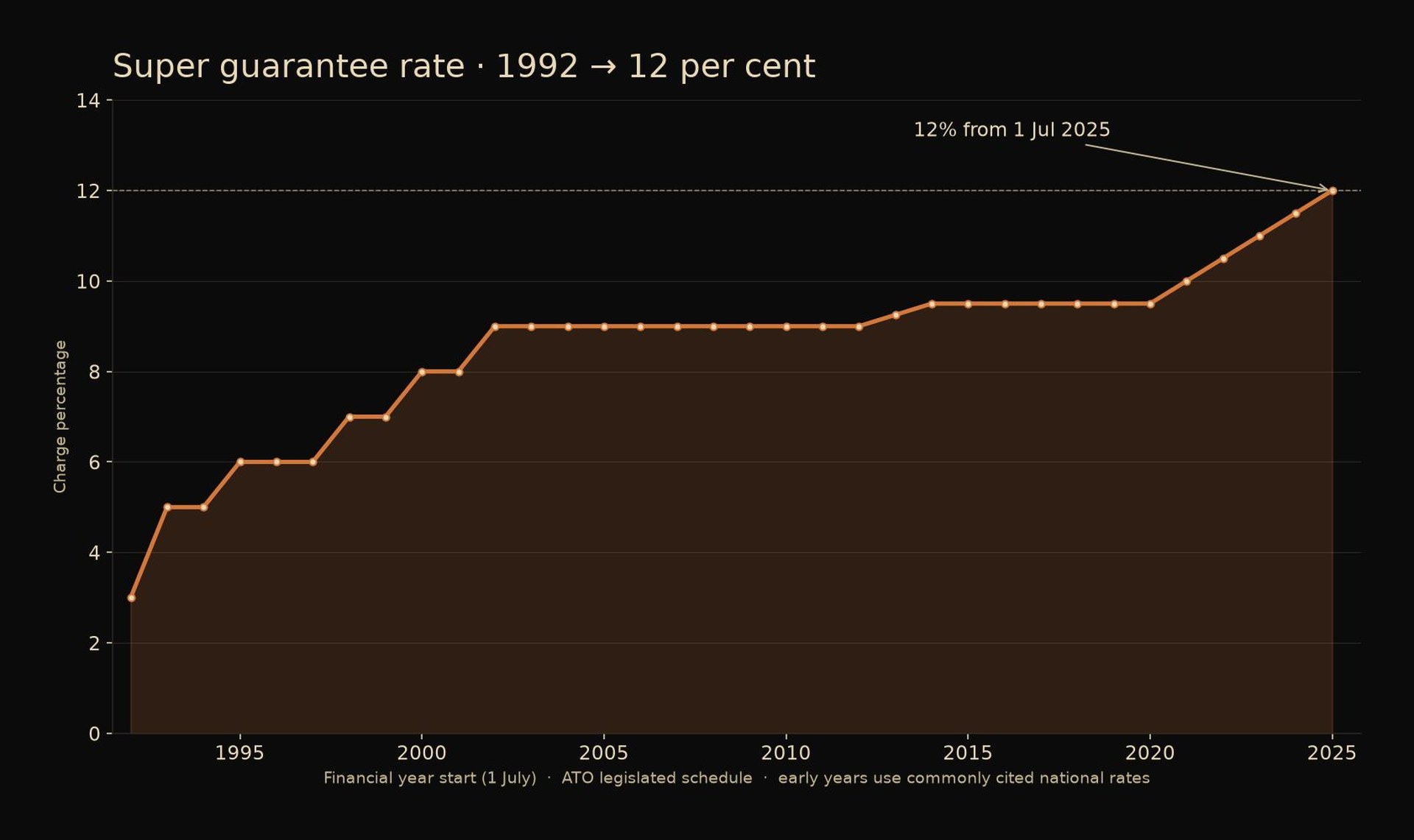
Now the boring machinery that makes the three per cent argument land. The Superannuation Guarantee charge percentage reached twelve per cent from 1 July 2025. That was the final step on the legislated ladder. No further rise is currently scheduled. From 1 July 2026, Payday Super changed the payment clock. Employers must get super guarantee contributions to the employee’s fund within seven business days after payday, calculated on qualifying earnings. The percentage is still twelve.
The Australian Taxation Office sets a maximum contribution base. For 2026–27 it is A$270,830 annual. Once an employee’s qualifying earnings hit that figure in the financial year, the employer is not required to pay further SG on additional qualifying earnings for the rest of that year. The ATO derives the figure from the concessional contributions cap — A$32,500 for 2026–27 — times one hundred, divided by twelve, rounded down to the nearest ten dollars. Those are ATO numbers. Use them when you argue about ceilings and caps. Do not invent others.
Why recite the ladder? Because One Nation’s opt-in is not a cut to the employer’s remittance rate. The remittance stays at twelve. The party’s move is a temporary reallocation of a quarter of that remittance — three of twelve — to the worker via the fund, taxed at fifteen per cent concessional, for people who are renting or servicing a mortgage, for up to three years. If you are arguing about “cutting super,” you need to say whether you mean the remittance rate, the preservation rules, or the retirement balance path. Those are three different knives.
Preservation is the word Chalmers keeps using. Under current rules, early access is tightly limited — compassionate grounds, terminal illness, incapacity, severe financial hardship, plus schemes such as First Home Super Saver for voluntary contributions. Joyce’s complaint is that hardship is convoluted and that even approved hardship money can be taxed at seventeen to twenty-two per cent. One Nation’s answer is a standing opt-in for renters and mortgage holders on future contributions, not a balance raid. Labor’s answer is that the opt-in is still a raid on the retirement path even if the balance sheet line for yesterday’s contributions does not move.
Let’s do the arithmetic the party did not publish as a costing sheet. These are worked examples from the twelve per cent math, labelled as such. They are not One Nation costings and they are not Treasury costings.
Take ordinary earnings of A$60,000 a year. Twelve per cent is A$7,200. Three per cent is A$1,800 before the concessional tax. After fifteen per cent, about A$1,530 would reach the person if the diversion worked as described. Nine per cent — A$5,400 — would still go to the retirement account for that year. Over three years at a flat wage, that is roughly A$4,590 after tax diverted across, and A$16,200 still contributed at the nine per cent floor, ignoring investment returns and wage changes.
At A$80,000, three per cent is A$2,400 gross, about A$2,040 after fifteen per cent. Nine per cent leaves A$7,200 in the fund for the year. At A$100,000, three per cent is A$3,000 gross, about A$2,550 after tax; nine per cent is A$9,000. At A$120,000, three per cent is A$3,600 gross, about A$3,060 after tax; nine per cent is A$10,800.
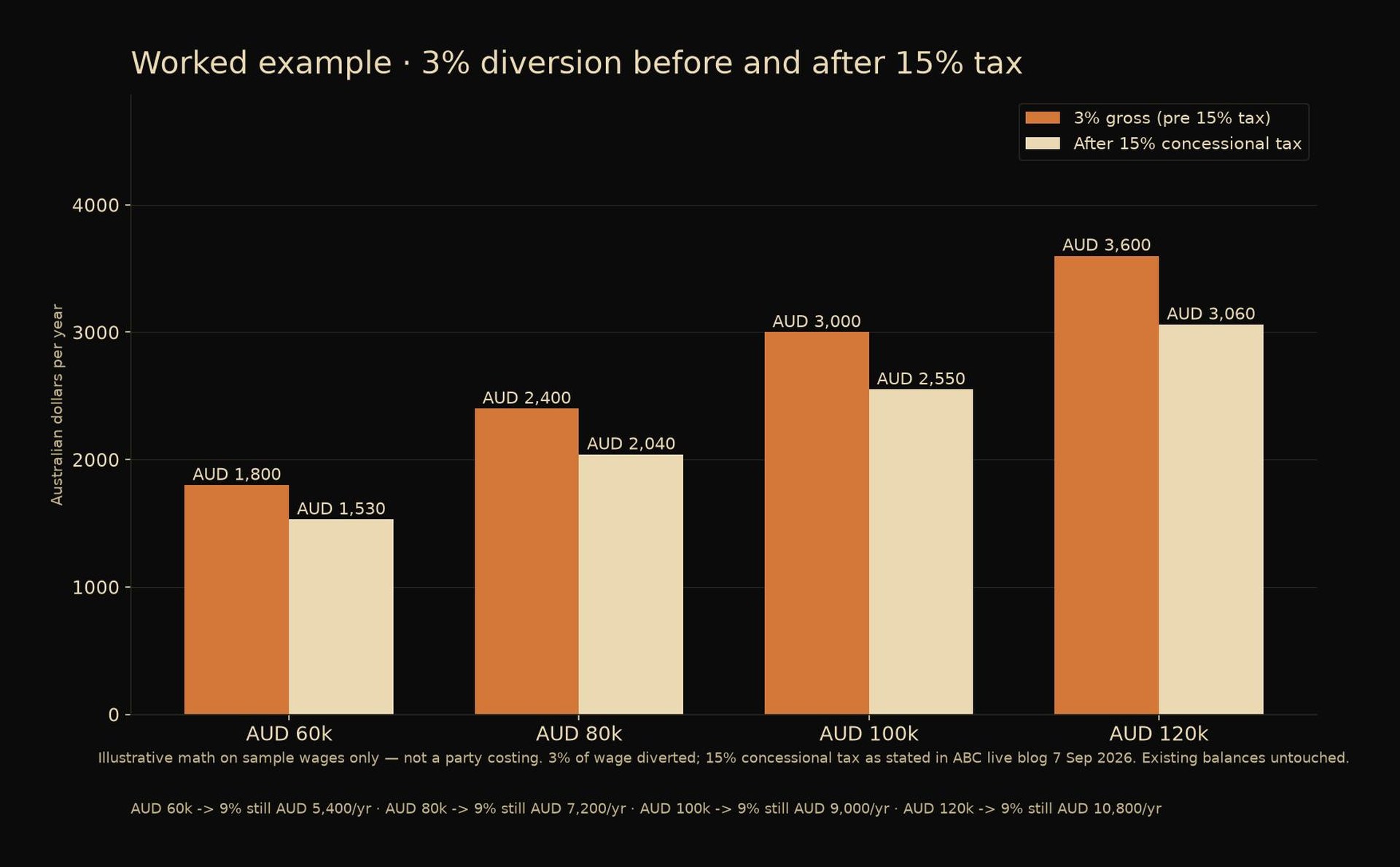
Plibersek’s “thousands of dollars worse off in retirement” claim is directionally about lost compounding on the diverted slice, not about a same-day balance clawback. Whether thousands is the right order of magnitude depends on wage, years diverted, investment returns, fees, and what the person does with the cash. Pay down a mortgage at six per cent and the trade-off looks one way. Spend the cash on groceries that would otherwise go on a credit card and it looks another. The paper is not going to invent a lifetime model One Nation did not publish. The paper will say the trade-off is real, the party’s own floor is nine per cent for up to three years, and Labor’s critique assumes the diverted dollars would have stayed invested.
Hume’s breakfast questions are the ones a desk still has to chase. How does a diverted three per cent sit against the concessional contributions cap? Does the amount paid to the person still count toward the cap even though it never lands as a preserved contribution? What reporting does the fund send the ATO? What happens if someone opts in mid-year, changes jobs, or stops renting? What proof of rent or mortgage is required? Is the three-year clock continuous or can it be paused? Monday’s announcement did not answer those on the live blog. Hume called that a habit. Joyce called the attitude change the point. Both can be true at once.
There is also the Payday Super interaction. From 1 July 2026, contributions have to reach the fund quickly after each payday. An opt-in diversion paid by the fund to the member adds another payment leg. Funds would need systems. Employers would need to know whether their remittance instructions change or stay identical while the fund handles the split. One Nation’s public lines on Monday stressed that the employer still pays twelve per cent. They did not publish an implementation paper with the breakfast grab.
Step back from the plumbing for a second. The political use of this policy is older than any PDF. Armstrong’s August column described Labor’s method: highlight Hanson’s record on workers’ rights and pay, warn that the Coalition cannot govern without One Nation, then argue the two share a policy agenda. Super is the issue of the month in that sequence. Paid parental leave was last month’s. The forty-two-dollar text naming Bragg and Hanson is the same bind with a price tag.
One Nation has punched back before. After Labor asked supporters for twenty-seven dollars to fight Hanson in June, Armstrong noted, One Nation’s “Fire the Liar” campaign raised more than A$4 million in five days and pulled unusual earned media. Hanson has also shown she can drop a prior position when it stops being useful — Armstrong’s example was the GST deal defence in Western Australia. Monday’s formal super policy is the opposite move: turning a suggestive line about early access into a numbered product.
Bragg’s National Press Club remarks remain part of Labor’s collage even though Monday’s announcer was Hanson, not Bragg. Labor’s ads and texts treat Coalition scepticism about compulsory super and One Nation’s access pitch as one threat. The Coalition’s Monday response, via Hume, was to separate itself — call One Nation’s plan a headline, demand detail, and not adopt the diversion. That is a different posture from Chalmers’ “any Coalition government with One Nation in it” line. Watch which of those postures survives the next joint sitting week argument.
Here’s a clean list — what Monday’s policy is on the public record, and what it isn’t.
It is an opt-in. Nobody is forced to divert. It is limited to people paying rent or a mortgage. It is limited to three years. It applies to future contributions. Existing balances are untouched on Hanson’s wording. The employer remittance stays at twelve per cent. The fund pays the three per cent to the person. The diverted slice still faces fifteen per cent concessional tax. At least nine per cent continues to retirement savings while the boost runs.
It is not, on Monday’s text, a cut to the legislated twelve per cent charge percentage. It is not a release of the current account balance. It is not a First Home Super Saver expansion. It is not the existing hardship pathway, which Joyce criticises as convoluted and higher-taxed when approved. It is not a published set of ATO consequential amendments. It is not a Coalition policy. Hume said as much by calling it a headline.
Labor will keep saying “raid” and “end super as we know it.” One Nation will keep saying “your own money” and “not one dollar” of the existing balance. Those slogans travel further than contribution-cap interaction notes. The desk’s job is to keep both the slogans and the interaction notes in the same story.
A word on compounding, and I’m not pretending to a proprietary model here. Three percentage points diverted for three years is nine percentage-point-years of contributions that do not sit in the fund during that window. After the window closes, the twelve per cent path resumes under current law unless further policy changes. The retirement difference is the forgone earnings on those diverted contributions, net of whatever return the household earned by using the cash — mortgage principal, rent arrears avoided, high-interest debt reduced, or consumption. Plibersek’s thousands-worse-off line assumes the investment path wins. Joyce’s keep-people-in-their-home line assumes housing stability can dominate a thin investment margin. Both claims are conditional. Neither was costed on Monday’s live blog.
For high earners near the maximum contribution base, the picture shifts again. The ATO’s A$270,830 annual base for 2026–27 caps the earnings on which SG must be paid. Diverting three of twelve on earnings below that base still shrinks the retirement contribution path for the opt-in years. Above the base, compulsory SG has already stopped for the year. Design questions Hume flagged — balance interaction, caps — get sharper for people who salary-sacrifice or who cycle near the cap. Monday did not resolve them.
Monday was also the start of a sitting fortnight. Gould’s blog noted the government wanted the week to talk up cracking down on tech giants — strengthening the social media minimum-age enforcement and the digital duty of care. One Nation’s super drop cut across that planned message discipline. Chalmers chose the House doors anyway. That tells you the Treasurer’s office rates the super fight as worth interrupting the tech grid.
Plibersek’s Seven grab and Hume’s News Breakfast grab landed before nine. Joyce’s Sydney “change in attitude” lines were on the blog by 8:49 a.m. eastern. By mid-morning the country had the full triangle: Labor existential, Coalition dismissive, One Nation proprietary. The afternoon chamber will recycle those lines. The policy substance will not grow more detailed unless the party releases an implementation brief.
If you are a renter or a mortgage holder trying to decide what this means for you personally, start with the legal status. This is a party proposal, not law. It does not change your next payday remittance. Your fund is not about to start paying you three per cent because of a Monday press plan. Any real-world diversion would need legislation, fund systems, ATO treatment, and proof rules for rent and mortgage status.
Second, separate cash-flow relief from retirement maths. A$2,000-odd after tax on an A$80,000 wage is real money in a year of high rents. It is also real money not compounding inside the fund for that year. You do not need a lecture about which goal is morally superior. You need the percentage table and a clear statement that the choice, as drafted, is yours for up to three years if the policy ever becomes law.
Third, do not confuse this with COVID-era early release, which drained balances directly. Hanson’s Monday wording is the opposite structure: future contributions only, existing balance untouched. Labor still calls it a raid because the retirement path shrinks. Those are different definitions of the same verb. Ask which definition a speaker is using before you share the clip.
Fourth, watch the Coalition. Hume’s “headline” line is a refusal to co-own the product. Chalmers’ “any Coalition government with One Nation in it” line is an attempt to force co-ownership in voters’ minds. Armstrong documented that force-bind strategy in August. Monday is the first formal One Nation product in that bind. How Liberal and National MPs talk about three-and-nine over the next fortnight will matter more than a single breakfast television adjective.
A quick walk along the guarantee’s history, because twelve per cent feels permanent until someone proposes to reallocate a quarter of it. Compulsory super began in 1992 at three per cent for many employees, then stepped through the 1990s toward nine. It sat near nine for a long stretch, edged to 9.25 then 9.5 in the mid-2010s, then climbed again from 2021: ten, 10.5, eleven, 11.5, and twelve from 1 July 2025. That last step is barely fourteen months old. Payday Super, in force from 1 July 2026, is only weeks into its life as the payment rule. One Nation is proposing a flexibility layer on top of a rate that has only just finished rising and a payment system that has only just changed clocks.
Funds and payroll offices are still bedding down qualifying-earnings definitions and seven-business-day settlement. Adding an opt-in diversion paid by the fund to the member is a new workflow. That does not make the idea impossible. It does explain why Hume can call for detail without inventing a scandal. Systems questions are not moral questions. They are still questions.
Joyce’s hardship comparison deserves a straight restatement. Today, severe financial hardship and compassionate grounds exist as gated exceptions. They are not a standing rent-or-mortgage switch. Approvals go through criteria. Joyce says the path is incredibly convoluted and that approved amounts can be taxed at seventeen to twenty-two per cent. One Nation’s opt-in would instead divert future concessional contributions at fifteen per cent tax for eligible renters and mortgage holders for up to three years, without touching the existing balance. That is a different legal animal from hardship release. Comparing the tax rates is fair. Equating the mechanisms is not.
Labor’s counter is less about the hardship form and more about the retirement income target. Plibersek’s “thousands of dollars worse off” and Chalmers’ “less economic security” both point at the end-state balance, not the application PDF. If the political argument stays at “raid versus own money,” voters never hear the hardship-versus-opt-in distinction. If the argument moves to implementation, they might.
What we still don’t know after Monday morning, stated plainly:
We do not know the legislative vehicle. We do not know the start date One Nation would target if it held the balance of power. We do not know the evidentiary test for rent or mortgage. We do not know whether the three years must be continuous. We do not know how salary-sacrifice interactions would be handled. We do not know how defined-benefit schemes or exempt public sector funds would be treated. We do not know whether the diverted three per cent would reduce reportable employer super contributions for other transfer purposes. We do not know the fund-side payment timing relative to Payday Super’s seven-business-day rule. We do not know a distributional costing by income decile. We do not know a retirement-income model under One Nation’s logo.
We do know the public numbers the party chose to put on television and into Gould’s blog: three percentage points, twelve per cent remittance unchanged, fifteen per cent concessional tax, nine per cent floor, three-year limit, renters and mortgage holders, future contributions only, existing balances untouched.
Australia’s compulsory super debate has always been a fight about time preference. Lock money away for old age, or release some of it when the rent ledger is loud. The modern system’s answer has been lockaway with narrow gates. One Nation’s Monday answer is a temporary, optional, partial unlock on the contribution flow for people already carrying housing costs. Labor’s answer is to treat that unlock as the beginning of the end of the system it has spent August binding to the Coalition. The Coalition’s breakfast answer is to refuse the product as unfinished.
None of those positions requires you to invent facts. The ABC live blog, SBS’s same-morning write-up, Armstrong’s 22 August analysis, and the ATO’s published SG and Payday Super parameters are enough to stand up the story. Secret Harbour showed One Nation can win a lower-house district under mortgage pressure. Monday showed the party will convert that pressure into a numbered super product. Chalmers showed he will meet it at the House doors. Hume showed the Coalition will not automatically wear it. Joyce showed the sales pitch will be ownership, competence, and housing.

One more pass on the August-to-September timeline, because Monday did not arrive from nowhere. Mid-August: Bragg at the National Press Club, Hanson talking early access, Chalmers warning that Liberals, Nationals and One Nation would end super as we know it. 22 August: Armstrong documents Labor digital ads binding Hanson to the Coalition on universal super, plus Chalmers genuinely worried quote and Hanson’s X rebuttal that the party is not ending super. 29 to 30 August: Secret Harbour falls to One Nation, already filed on this desk. 7 September: the numbered product drops — three points, three years, fifteen per cent concessional, nine per cent floor.
That sequence matters for readers who only saw the breakfast television grabs. The ads came first. The by-election came second. The policy product came third. Labor will say the policy proves the ads. One Nation will say the policy proves the rebuttal — not ending super, reshaping access. Hume will say neither proof is complete without detail. Keep the calendar straight when the clips get cut to twelve seconds.
SBS filed the same morning, confirming the same architecture: rent or mortgage, up to three years, employer still on twelve per cent, fund pays three per cent to the member, fifteen per cent concessional tax, Hanson on breathing room, Joyce on competence and convoluted hardship, Plibersek on raiding super and thousands worse off, Hume on headline without details. When two national outlets carry the same skeleton before lunch, you can treat the skeleton as solid even while the implementation annex is missing.
About the tax rate again, because it is easy to blur. Marginal income tax on wages can sit well above fifteen per cent for many full-time workers. One Nation’s diverted slice, as described, stays inside the concessional contribution tax setting of fifteen per cent rather than being paid as ordinary wages taxed at the marginal rate. That is a design choice with winners and losers depending on the person’s bracket and on what else sits in their concessional cap for the year. It is also why calling the diversion a simple “pay rise” is imprecise. It is contribution-taxed money redirected, not a new employer wage cost above the twelve per cent remittance.
Employers listening for a cost shock should hear this clearly: on Monday’s description, the employer remittance does not rise and does not fall. Twelve per cent remains twelve per cent. The change sits between the fund and the member. Payroll still calculates SG. The fund, if the law ever lands this way, becomes the body that peels three points across to the member’s bank details. That is why fund systems and ATO reporting are not side issues. They are the product.
For household budgets, the after-tax diversion examples earlier are annualised. Real pay cycles are weekly, fortnightly, or monthly. A renter on A$80,000 looking at roughly A$2,040 a year after fifteen per cent is looking at about A$78 a fortnight before any other offsets. That will not rewrite a capital-city rent ledger on its own. It may cover a power bill quarter or a chunk of groceries. Joyce’s housing-stability argument is about the margin at the edge of arrears, not about a new deposit scheme. Keep the scale honest when you share the chart.
For retirement balances, honesty runs the other way. Three years of missing three percentage points is not nothing. It is also not the same as emptying the account. Hanson’s “not one dollar” line is about the stock already saved. Plibersek’s “thousands worse off” line is about the flow not saved and not compounded. Both can be factually framed without pretending the other is lying about a different noun.
Finally, the desk note on what this paper is not doing today. We are not refiling Secret Harbour. We are not restating the entire Bragg Press Club transcript. We are not publishing house rules. We are filing the Monday policy drop with the August ad context, the ATO rate and base figures, the live-blog quotes, and the worked examples labelled as maths, not costings. If One Nation releases an implementation brief, that is a new story. If Chalmers tables a formal attack in the chamber with new numbers, that is a new story. Monday’s story is the product launch and the three-way reaction.
Put the reader question another way. If you rent in Adelaide or carry a mortgage in the outer suburbs, does a three-year opt-in at three percentage points change your next decision, or is it a federal argument you watch from the couch? Until legislation exists, it is the couch. The value of Mondays drop is clarity about what One Nation will take to any negotiation with a minority Coalition. Chalmers is already pricing that negotiation as a super cut. Hume is pricing it as unfinished paper. Joyce is pricing it as attitude. Those prices are now on the public board.
The guarantee climbed for a generation to reach twelve per cent. Payday Super just changed when that twelve per cent must arrive. One Nation wants a temporary, optional split of the flow for housing-cost households. That is a concrete proposal. Treat it as one. Demand the missing annex. Do not confuse it with a balance raid, and do not pretend the retirement-path cost is zero. Mondays record is strong enough to hold that double standard without embroidery.
The guarantee is twelve per cent. Payday Super is live. The maximum contribution base for 2026–27 is A$270,830. One Nation wants three of those twelve points available as an opt-in cash path for renters and mortgage holders for up to three years, taxed at fifteen per cent concessional, with nine per cent still going in. Labor says that ends super as we know it. The Liberals’ deputy leader calls it a headline. That is the story as of Monday, 7 September 2026. Further detail belongs to the next release, not to guesswork.
The paper
Comments
No notes on this story yet.
Sign in to comment